Structural pruning helps young trees in Concord, NH develop stronger trunks, better branch attachments, and a more stable crown before structural problems become difficult to correct. We focus on selecting a dominant leader, managing competing stems, spacing future permanent branches, and preserving enough foliage for the tree to keep growing. These early decisions can reduce the likelihood of certain branch failures as the tree matures.
At Technical Tree Service, we provide arborist services in Concord, NH for homeowners and property owners who want their young trees to develop a sound structure.
New Hampshire’s wet snow, freezing rain, and strong winds make branch architecture worth paying attention to. A young maple with two competing trunks may look perfectly healthy today, but those stems can become much harder to manage once they grow large.
We would rather address a structural problem while the branches are small than wait until correcting it requires removing a substantial part of the tree.
What Is Structural Pruning?
Structural pruning is the selective removal or reduction of branches to guide how a tree develops.
The goal is to establish a sound framework that can support the tree as it gains height, diameter, and crown weight.
We look at which stem is becoming dominant, where permanent branches are forming, how those branches attach to the trunk, and whether competing growth is likely to create structural problems later.
That is different from simply cutting branches to make the tree shorter or more symmetrical.
A young tree can have an uneven appearance while developing perfectly reasonable structure. Another may look balanced from the driveway but have two nearly equal stems growing from a weak attachment.
We pay more attention to how those branches will develop than whether the crown looks perfectly shaped after one pruning visit.
Why Young Trees Need Different Pruning Than Mature Trees
A branch that is one inch in diameter is easier to manage than the same branch after it has grown into a major limb.
When we identify a competing leader early, we may be able to shorten it with a relatively small pruning cut.
That allows the selected leader to continue growing while the competing branch becomes less dominant.
If both stems are allowed to grow at similar rates for another 15 or 20 years, removing either one could leave a large wound and eliminate a substantial portion of the crown.
The options become more limited as the tree matures.
This is one reason we consider structural pruning part of long-term tree maintenance in Concord, NH.
Young trees may need relatively small adjustments over several growing seasons. Mature trees often require a more cautious approach because large branches, existing decay, and established structure limit what can reasonably be changed.
Start With the Central Leader
For many large shade trees, we want one clearly dominant upright stem through the developing crown.
This is called the central leader.
It provides a main structural axis around which lateral branches can develop.
Young red maples, sugar maples, and other landscape hardwoods may develop competing upright stems if several vigorous shoots begin growing at similar rates.
We look at their attachment points, relative sizes, and growth directions before deciding which stem should become dominant.
The best leader is not necessarily the tallest shoot.
A slightly shorter stem with a favorable attachment and position may be a better long-term choice than a vigorous stem growing from a poor union.
Two Upright Stems Can Become a Problem Later
When two stems of similar diameter originate from the same area, they are called codominant stems.
They may develop included bark where the stems meet.
Instead of forming a strong connection with supporting wood, bark becomes trapped inside the union as the stems expand.
That attachment can be more vulnerable to splitting under enough force.
We want to identify these arrangements while the tree is young enough to make smaller corrections.
Our discussion of weak branch unions in Bow, NH explains how included bark, stem size, cracks, and other conditions affect structural assessment.
A narrow union alone does not establish that a tree will fail. We still evaluate the attachment and how the competing stems are developing.
We Do Not Always Remove a Competing Leader Completely
A young tree may have one stem growing almost as strongly as the main leader.
Removing that entire stem is sometimes appropriate, particularly when it is still small and its removal will not take away too much live foliage.
Other times, we can shorten the competing stem and allow the selected leader to gain dominance.
This approach is called subordination.
By reducing the length and foliage of a competing branch, we slow its growth relative to the main stem.
Over time, the branch may remain as a smaller lateral limb rather than developing into another large trunk.
That can preserve useful foliage while reducing the likelihood of an unfavorable attachment becoming more pronounced.
Why Subordination May Take More Than One Visit
Some branches need repeated attention as the tree grows.
A vigorous competing stem may continue extending after the first reduction.
We can evaluate its growth during later inspections and adjust it if necessary.
Trying to complete every structural correction in one visit can remove more living crown than the tree should lose at that stage.
We prefer a pruning objective that accounts for the tree’s condition, age, and likely response.
The goal is to guide its development without creating a different problem through excessive cutting.
Branch Diameter Matters as Much as Branch Angle
Homeowners often look at the angle where a branch joins the trunk.
A narrow V-shaped attachment can deserve attention, especially when included bark is present.
But angle is only one part of the evaluation.
We also compare the diameter of the branch with the diameter of the supporting stem.
A permanent branch that remains substantially smaller than the trunk generally has a more favorable size relationship than one that becomes nearly equal in diameter.
Structural-pruning research commonly uses a target of keeping permanent branches around half the diameter of the supporting stem or less where appropriate.
That does not mean every branch exceeding that ratio should be removed immediately.
We may instead reduce a rapidly growing branch so it develops more slowly while the trunk continues gaining diameter.
On a young tree, that adjustment can be made before the branch becomes too large to manage without a substantial wound.
Permanent Branches Need Room to Develop
Several branches emerging from nearly the same height can create crowded attachments as the tree grows.
We look for a distribution of permanent branches along the trunk rather than allowing all the major limbs to originate from one narrow section.
We also consider how the branches are arranged around the tree.
If most of the permanent crown develops on one side, the structure may become unbalanced as those branches gain weight and length.
A well-distributed framework helps spread branch loads across the trunk.
For large-maturing trees, structural-pruning guidance often describes eventual vertical spacing of approximately 12 to 18 inches between permanent branches. Smaller ornamental trees may have closer spacing.
Those measurements are planning references, not instructions to remove every branch that falls outside a fixed spacing pattern.
The appropriate arrangement depends on the species, growth habit, and mature size.
Do Not Choose Permanent Branches Solely by Their Present Height
A branch that seems well positioned on a six-foot young tree may be too low for the intended use of the property when the tree matures.
We consider whether the tree will eventually grow beside a driveway, walkway, lawn, or open area.
Branches that will need clearance later may be treated as temporary branches during early development.
That allows the tree to keep the foliage it needs while we gradually establish its permanent crown higher on the trunk.
Removing all lower branches immediately can interfere with trunk development.
Lower Temporary Branches Help the Trunk Develop
It is tempting to prune a young tree until it looks like a smaller version of a mature shade tree.
That often means removing most of the lower branches.
We do not want to raise the crown too quickly.
Lower temporary branches provide foliage and contribute to the trunk’s diameter growth.
They also help develop trunk taper, the gradual change in diameter from the lower trunk upward.
A tree with a tall, narrow trunk and a small tuft of foliage near the top may not be developing the structure we want.
Keeping temporary branches for several years can support better growth while the main stem becomes established.
Those branches can be shortened or removed gradually as the permanent crown develops.
How Much Live Crown Should a Young Tree Keep?
Structural-pruning guidance commonly recommends retaining foliage over approximately the upper two-thirds of a young tree’s stem.
That is a useful way to avoid raising the crown too aggressively.
But the appropriate live crown ratio depends on the tree and its stage of development.
We consider the amount of healthy foliage, the existing structure, the species, and what has already been removed.
The objective is to preserve enough photosynthetic capacity and growing surface for the tree to continue developing.
Cutting every lower branch for appearance can work against that objective.
When Should You Start Structural Pruning After Planting?
A newly planted tree needs time to establish its root system.
We generally avoid aggressive structural pruning immediately after planting unless there is damaged, broken, or clearly problematic growth that needs attention.
The timing for more deliberate structural work depends on how quickly the tree establishes and resumes normal growth.
For many trees, that may take around one or two years. Larger transplants or trees under difficult growing conditions can take longer.
We want to see that the tree is growing well before removing a substantial amount of healthy foliage.
A tree still recovering from transplanting may benefit more from appropriate watering, mulch management, and protection of the root area than from additional canopy reduction.
Our tree health assessment service can help determine whether a young tree is ready for pruning or whether a growing-condition problem should be addressed first.
Late Winter Is Often a Good Time for Structural Pruning in Concord
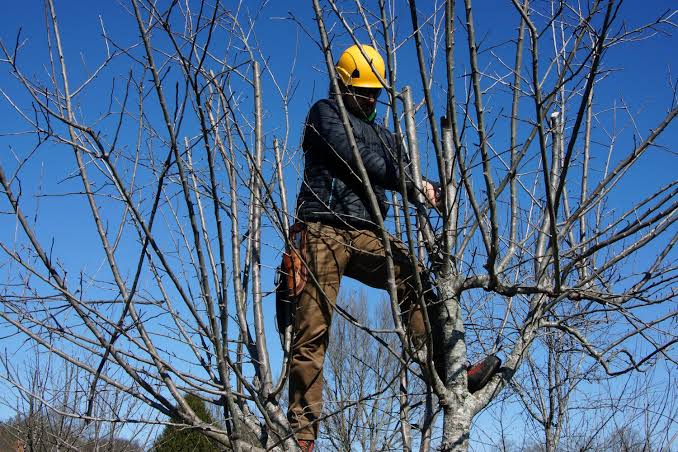
For many deciduous shade trees, late winter is a practical time to evaluate branch structure.
Without leaves, we can see the main leader, branch attachments, competing stems, and crowded growth more clearly.
We also have a better view of how the developing crown is organized.
Pruning while the tree is dormant can be appropriate for many species, with growth resuming as spring arrives.
That does not mean every tree should be pruned on the same winter schedule.
Species, condition, disease concerns, and the purpose of the work can change the timing.
If a tree has broken branches after a storm, the priority may also be different from routine developmental pruning.
Summer Inspections Can Reveal Other Problems
Leaves make it harder to see some branch attachments, but the growing season provides other information.
We can see which sections are producing vigorous growth, whether competing shoots are extending rapidly, and whether parts of the crown are declining.
That can help determine the next pruning objective.
A tree with abnormal leaf color, poor growth, or root stress may need a health evaluation before additional live branches are removed.
We consider the condition of the tree rather than selecting a pruning date based only on the calendar.
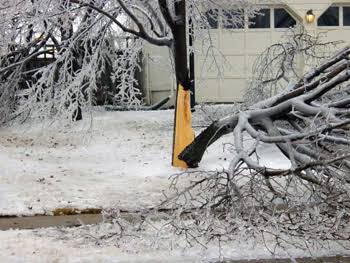
New Hampshire Snow and Ice Make Early Branch Structure Worth Attention
A young tree may look strong during summer and still have developing branch attachments that deserve attention before they become large.
Heavy wet snow can collect on branches and add considerable weight.
Freezing rain coats wood and twigs with ice.
Wind can move the crown while it is carrying that additional load.
For a tree with two competing leaders or a poorly formed branch union, that combination can place more force on an attachment that was already less favorable.
We cannot prune a tree so that it will withstand every future storm.
But we can identify structural conditions that may become more difficult to manage as the tree grows.
On properties in Concord and nearby Bow, that means looking at how young maples, oaks, and other landscape trees are developing before their main branches become heavy.
Different Tree Species Need Different Structural Goals
We would not prune every young tree into exactly the same form.
A shade maple, an ornamental birch, and a white pine have different natural growth habits.
The structure we encourage should make sense for the species.
Young Maples
Maples can develop closely spaced branches and competing upright stems, particularly when grown in open landscape conditions.
We look at the main leader, the relative sizes of lateral branches, and the development of any weak unions.
Reducing vigorous competitors while they are small can help establish a more favorable framework.
Young Oaks
Many young oaks naturally develop a reasonably distinct main leader, although branch structure still needs attention.
We consider crowded growth, damaged limbs, and competing stems when they appear.
Pruning decisions also need to account for species-specific health concerns and appropriate seasonal timing.
Birches and Other Multi-Stem Trees
Some birches are intentionally grown with several trunks.
We do not automatically try to turn every multi-stem ornamental tree into a single-leader specimen.
Instead, we evaluate whether the intended form is appropriate and whether the stems have reasonable attachments and room to develop.
That is different from allowing two unplanned codominant stems to develop on a large shade tree intended to have one main trunk.
Young White Pines and Other Conifers
Many conifers naturally form a dominant central leader.
We want to preserve that growth pattern when possible.
If a young pine loses its terminal leader, competing shoots may develop near the top.
We evaluate which shoot can reasonably assume the leading role and whether corrective pruning would help.
Removing healthy branches indiscriminately is not a substitute for that structural assessment.
How Much of a Young Tree Can Be Pruned at One Time?
Removing too much live foliage can affect the tree’s ability to grow and recover.
A commonly cited upper limit is 25% of the live crown in a pruning cycle, but that is not a target amount to remove.
For many young trees, considerably less is appropriate.
We base the amount of pruning on the tree’s age, vigor, species, growing conditions, and the structural objective.
A newly established tree with limited foliage may need very little pruning.
A vigorous tree with one small competing leader may require only a few carefully selected cuts.
We do not remove a quarter of the crown simply because a general guideline allows that amount.
Preserving healthy foliage is part of developing a young tree.
Proper Pruning Cuts Matter While Branches Are Small
The location of the cut affects how the tree responds.
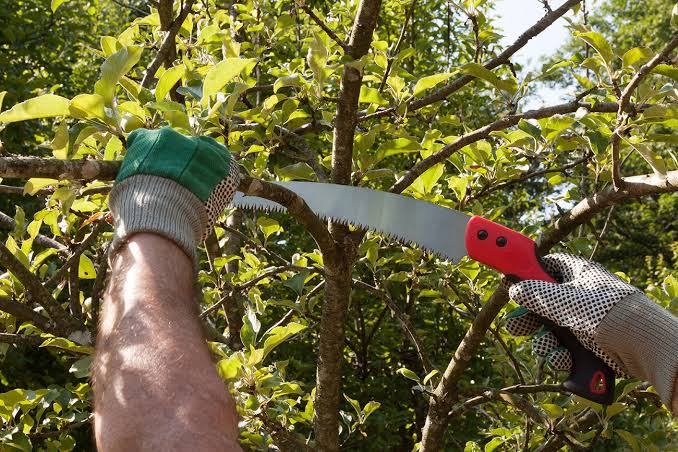
When removing a branch, we want to avoid cutting into the branch collar, the area of tissue around its attachment to the supporting stem.
A flush cut removes supporting tissue that should remain.
Leaving a long stub also creates an undesirable wound configuration.
The correct cut is generally made just outside the branch collar, without damaging the supporting trunk.
For larger branches, a three-cut method can reduce the chance of bark tearing as the branch is removed.
That begins with an undercut to prevent a falling branch from stripping bark down the trunk.
The main branch weight is then removed before the final pruning cut is made near the attachment.
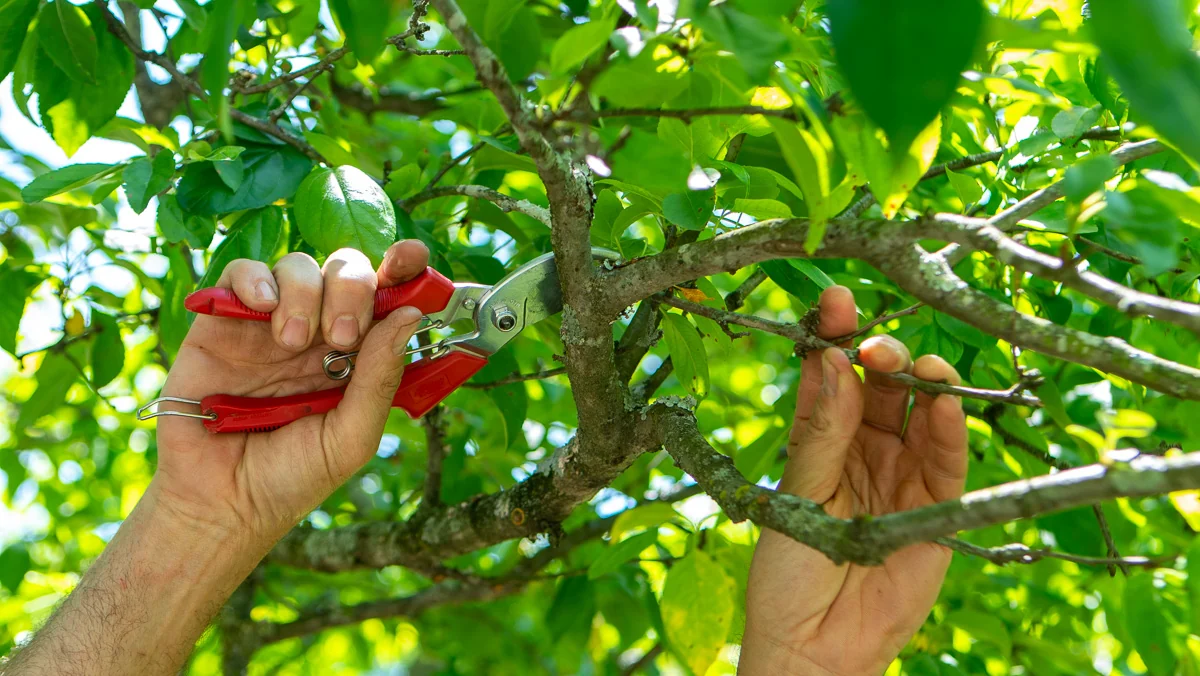
For small live branches, bypass pruners can make clean cuts when they are appropriate for the branch diameter.
Regardless of the tool, we want sharp cutting edges and suitable sanitation practices, especially when a tree-health concern makes disease transmission relevant.
Our professional tree trimming service includes pruning for structural development, branch clearance, and other objectives based on the tree’s condition.
Topping a Young Tree Can Create Problems Instead of Correcting Them
Cutting the top off a young shade tree may seem like a quick way to control its height.
It also removes the leader we may have been trying to preserve.
The tree can respond by producing several vigorous shoots near the cut.
Those shoots may compete with one another and develop attachments that need additional management later.
Large or poorly placed topping cuts can also expose wood to decay.
If a young tree is growing toward a space where it cannot reasonably reach its mature size, we need to evaluate whether the species and planting location are suitable.
Repeatedly cutting the top back is not a sound structural plan.
A Young Tree Near a Driveway Needs a Longer-Term Plan
A homeowner may plant a tree beside a driveway and want the lowest branches removed immediately for clearance.
We understand the objective.
But if the tree is still young, removing every lower branch can interfere with trunk development.
We may be able to retain selected temporary branches while keeping the necessary access clear.
As the tree grows taller and develops better trunk taper, those temporary branches can be reduced or removed gradually.
This is one reason an early pruning plan should account for how the property will be used in the future.
A tree beside an open lawn may have different clearance requirements from one next to a driveway, sidewalk, or building.
We evaluate the intended mature form along with those practical property needs.
When a Young Tree Needs Monitoring Instead of Another Cut
Not every developing branch requires immediate pruning.
Sometimes the tree has a reasonable central leader, acceptable branch distribution, and no obvious structural defect that calls for intervention.
We may recommend allowing it to grow before making further changes.
Monitoring is more useful when we know what we are watching.
That might be a competing shoot beginning to gain diameter, a branch becoming too large relative to its supporting stem, or a section of the crown developing crowded growth.
The tree can be reevaluated as those features change.
For a property owner with several young trees, this approach also helps prioritize which trees need work now and which can continue growing without additional cuts.
Our tree care consultations can help establish an appropriate maintenance plan based on the species, planting location, and current development of the trees.
How Often Should Structural Pruning Be Revisited?
A young tree can change considerably over a few growing seasons.
Structural-pruning research recommends regular inspections during the early development period, often annually during the first decade after establishment.
That does not mean every tree needs pruning every year.
We might inspect a tree, find that the central leader is developing well, and recommend no cutting at that time.
Another tree may need one competing branch reduced before it becomes larger.
For large-maturing shade trees, structural development may continue to need attention beyond the first ten years.
Intervals between pruning work can often become longer as the framework develops, depending on the species and growth rate.
We would rather base those decisions on what the tree is doing than follow an automatic annual cutting schedule.
Structural Pruning Is Different From Clearance Pruning
A branch touching the roof may need attention because of where it is growing.
A competing leader may need attention because of how it is developing.
Those are different pruning objectives.
Clearance pruning focuses on providing adequate separation from buildings, walkways, driveways, and other property features.
Structural pruning focuses on the long-term arrangement and strength of the crown.
Sometimes the same pruning operation can address both concerns.
But we do not want to remove a branch solely for clearance without considering what that cut will do to a young tree’s development.
Our article on professional tree trimming in Concord, NH explains the broader purposes of pruning, including crown care, clearance, and maintenance.
What We Check Before Recommending Structural Pruning
We start by looking at the tree as it is growing now.
The species tells us something about its natural form.
We then look at the central leader, branch sizes, attachments, spacing, temporary lower branches, and distribution of foliage.
The root area and overall vigor matter too.
A tree with poor growth after planting may need its growing conditions addressed before additional live branches are removed.
We also look at where the tree stands.
A young shade tree beside a house, parking area, or driveway may need a different long-term crown arrangement from one growing in an open field.
Not every tree will benefit from the same cuts, and not every structural concern should be corrected in a single visit.
We want a plan that makes sense as the tree continues growing.
Give Young Trees a Better Structure While Changes Are Still Small
Technical Tree Service is based in Bedford, New Hampshire, and provides tree care for homeowners and commercial property owners in Concord, Bow, and surrounding southern New Hampshire communities.
Our services include arborist assessments, tree trimming, structural pruning, health evaluations, and ongoing tree maintenance.
If you have young maples, oaks, pines, or ornamental trees developing competing trunks, crowded branches, or an uneven crown, call us at (603) 438-5956.
We can look at how the tree is growing and help determine whether selective pruning would improve its future structure.
Sometimes that means reducing a competing leader. Sometimes it means keeping a lower branch for a few more years. And sometimes the tree is developing well enough that we recommend leaving it alone for now.
The right decision depends on what the tree needs at its present stage of growth.