Tree Service in Dunbarton, NH
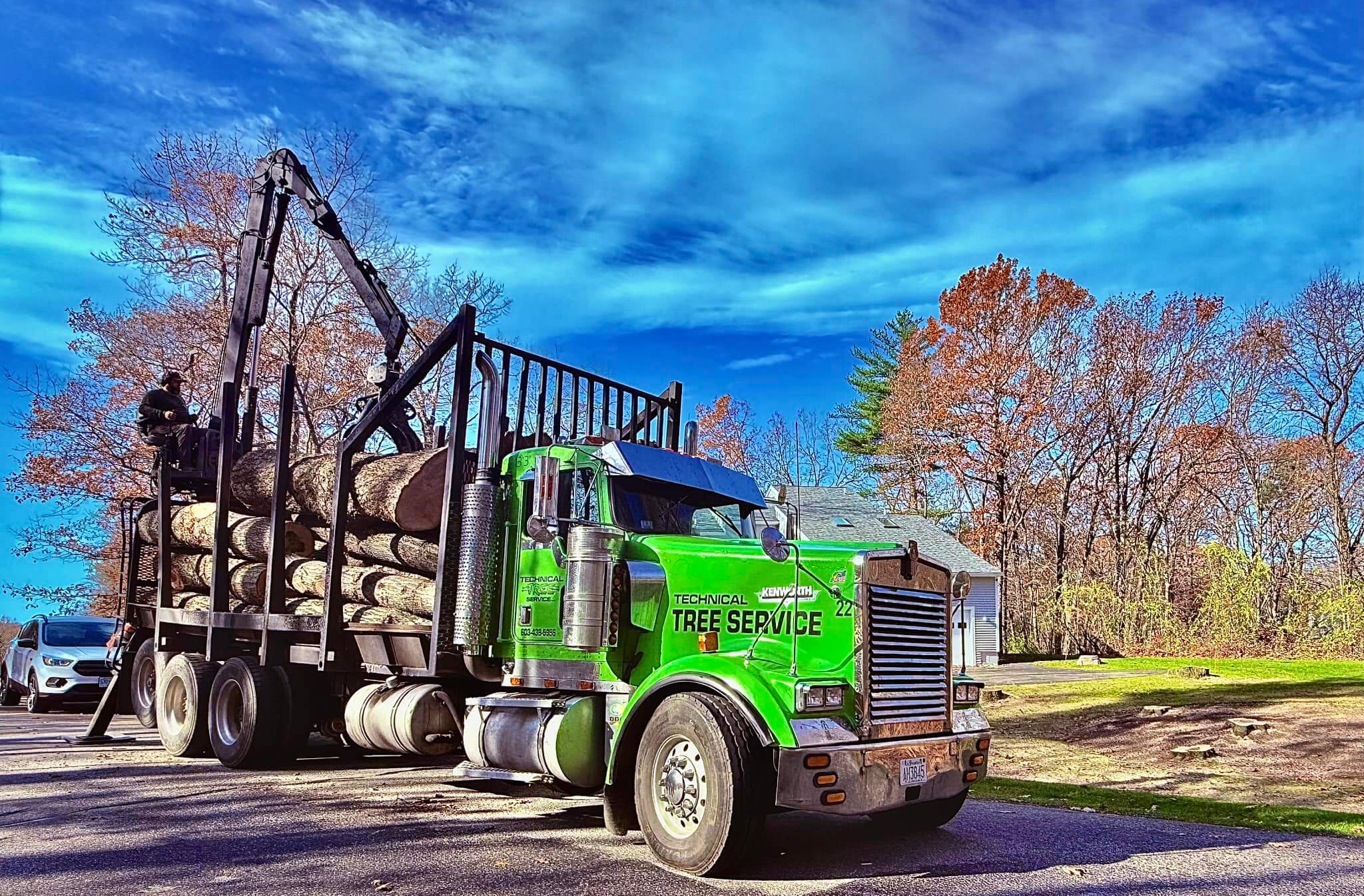
Technical Tree Service provides tree service in Dunbarton, NH for homeowners with hazardous trees, storm damage, overgrown branches, declining trees, stumps, and large trees that require controlled removal. Our team includes ISA Certified Arborists, we are fully insured, and we own cranes for jobs where lifting tree sections is safer than dropping them through the property.
Dunbarton presents a different working environment from a dense city neighborhood. Long driveways, wooded lots, field edges, stone walls, wetlands, narrow rural roads, and mature trees close to homes or barns can all affect how tree work should be planned.
Planned work starts with an on-site inspection rather than a price based on a photograph or tree height. For an immediate tree hazard, Technical Tree Service provides 24/7 emergency service with response in Dunbarton within 1 hour.
Tree Care for Dunbarton’s Wooded and Rural Properties
Dunbarton’s landscape includes large forest blocks, residential woodlots, fields, wetlands, and properties where mature trees stand close to houses, barns, driveways, stone walls, and utility lines.
That mix changes tree-care decisions. A mature oak at the edge of an open field receives different wind exposure from an oak protected inside a stand. A white pine beside a long driveway may create a different risk than the same species growing deep in a wooded section where there is no occupied target beneath it.
The useful question is not simply whether a tree is large. Its condition, exposure, root support, defects, surrounding targets, equipment access, and role within the surrounding stand all matter.
An ISA Certified Arborist can evaluate those conditions before recommending pruning, monitoring, treatment, or removal.
Tree Removal in Dunbarton
Removal may be appropriate when a tree is dead, severely declining, structurally compromised, uprooted, storm-damaged, interfering with a project, or positioned where failure could cause unacceptable damage.
Technical Tree Service provides tree removal in Dunbarton, NH for residential and wooded properties.
The removal method depends heavily on the site. An open tree with a suitable drop zone may allow one approach. A large tree beside a house, barn, garage, driveway, fence, utility line, or stone wall can require sectional dismantling and controlled handling.
Access also matters on larger rural parcels. The closest path to the tree is not always the right route for heavy equipment. Ground condition, slopes, drainage, walls, septic areas, landscaping, and available turning space can all influence the setup.
Tree Trimming and Pruning for Mature Trees
A tree that creates a concern does not automatically need to be removed. Dead branches, excessive end weight, clearance conflicts, broken limbs, and some structural problems can often be addressed through pruning.
Our tree trimming and pruning service is based on what the tree needs rather than simply reducing the canopy as much as possible.
On Dunbarton properties, pruning may be used to remove deadwood above a driveway, create clearance from a roof or barn, reduce weight on an extended limb, address storm damage, or improve structure while retaining the tree.
Heavy cutting can create its own problems. Removing too much live canopy at once changes the tree’s energy balance, wind loading, and response growth. The amount and location of pruning should match the species, condition, age, and objective.
White Pine, Oak, Maple, Hemlock, and Birch in Dunbarton
Dunbarton’s wooded landscape includes white pine, oak, maple, hemlock, birch, and other New Hampshire species. Those trees do not respond to wind, snow, insects, decay, or clearing in the same way.
White pine deserves attention after changes around a wooded property. If surrounding trees are removed, the remaining pines can suddenly receive wind from directions and at intensities they did not experience while protected inside the stand.
That does not mean a newly exposed pine should automatically be removed. Root condition, soil moisture, height, lean, crown condition, stand history, and what lies within striking distance still need to be considered.
Mature oaks can carry large limbs over long distances. Maples may develop included unions or decay around old wounds. Hemlocks in New Hampshire continue to face pressure from hemlock woolly adelgid and related pests.
A tree-health problem also does not automatically become a removal problem. Our tree health assessments can help determine whether monitoring, pruning, treatment, or removal fits the condition found on the individual tree.
Tree Problems After Clearing or Opening a Wooded Lot
Removing several trees can change conditions for the trees left behind.
Trees growing inside a forest stand develop with neighboring crowns and trunks buffering some wind. Once a driveway is widened, a house lot is opened, or several mature trees are removed, the new forest edge receives more direct exposure.
This deserves particular attention with tall white pines. New Hampshire forestry guidance identifies white pine as highly susceptible to wind damage and notes that exposure, shallow or wet soils, stand age, and stand density all influence vulnerability.
Before clearing multiple trees near a house or opening a large section of a wooded property, it can be useful to evaluate the trees that will remain, not only the ones scheduled for removal.
A tree that appears protected before the work may become the most exposed tree on the property after neighboring trees are gone.
24/7 Emergency Tree Service With Response Within 1 Hour
A tree across a driveway can be a major problem on a rural property even when it has not struck the house. A split tree over a roof, uprooted pine leaning toward a structure, hanging limb, or tree on utility lines requires an even more controlled response.
Technical Tree Service provides 24/7 emergency tree service with response in Dunbarton within 1 hour for emergency calls.
Storm damage can leave wood under heavy tension. Broken tops may remain suspended, one fallen tree may be supporting another, and root plates can move as sections are cut away.
If several trees or large amounts of material are down, our storm damage cleanup service can address fallen trees and debris while the remaining trees are checked for immediate hazards.
Stay away from trees touching electrical conductors and from suspended sections that have not been stabilized. A tree can appear motionless while carrying considerable stored force.
Crane-Assisted Tree Work on Rural Properties
Owning more land does not always mean there is more usable room around a tree. A property can be several acres while the problem tree stands between the house, barn, septic area, overhead wires, and a stone wall.
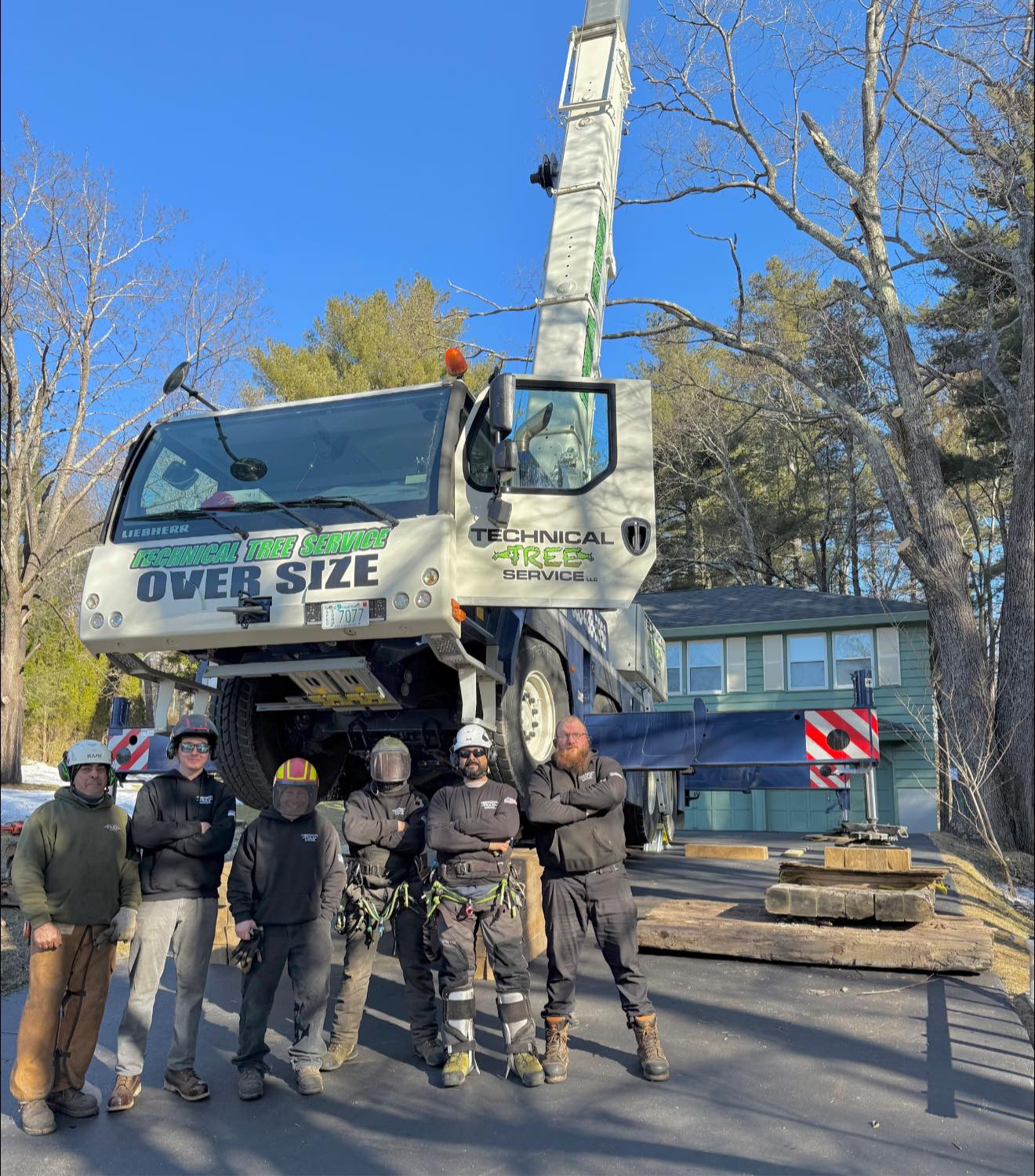
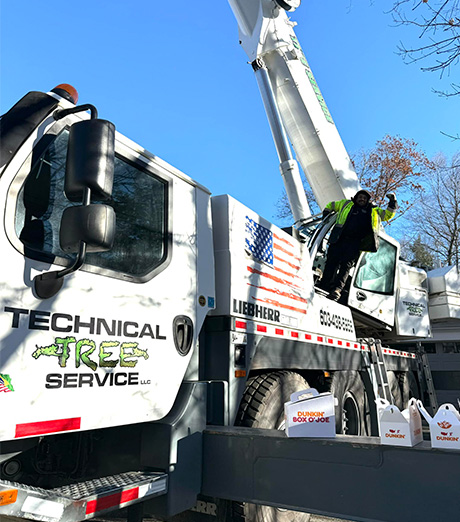
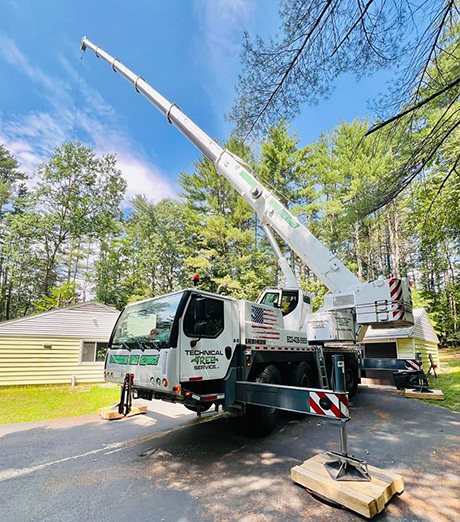
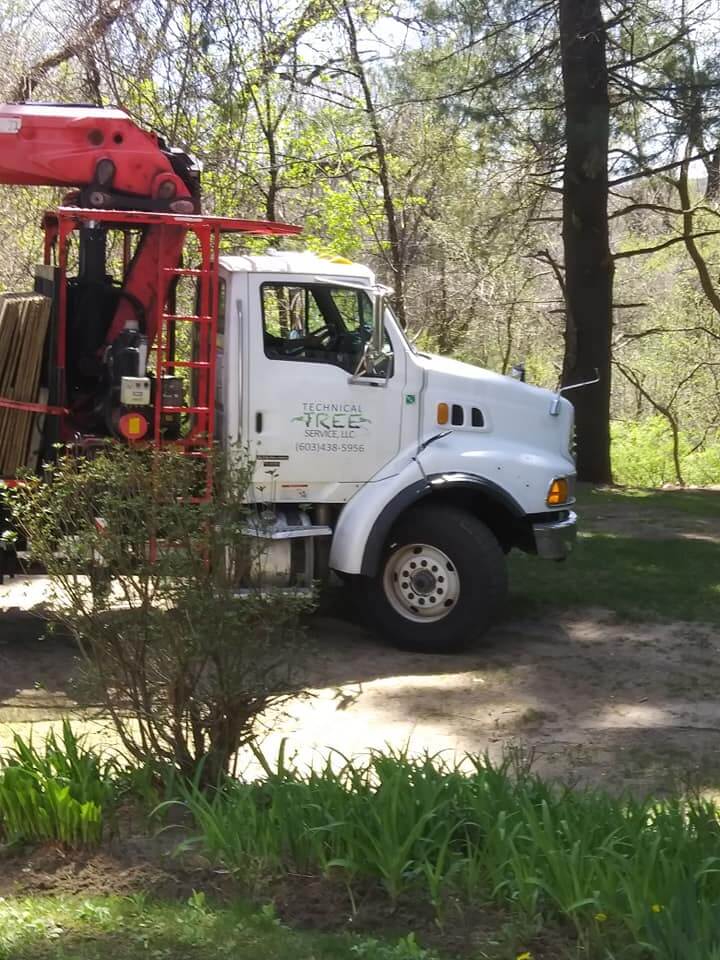
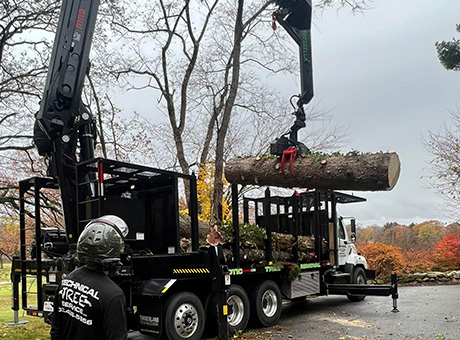
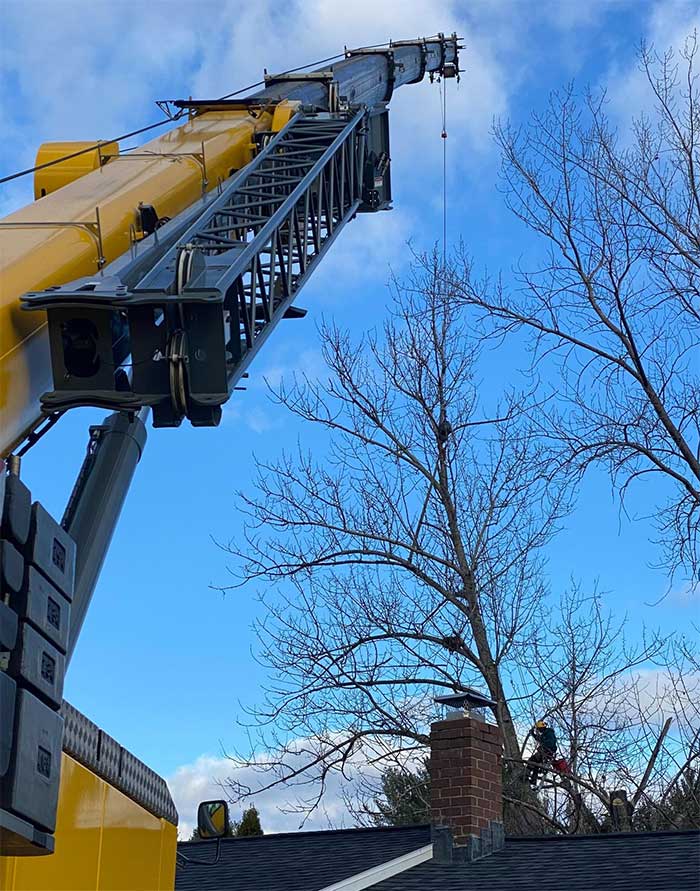
Technical Tree Service owns cranes that can be used when the site benefits from controlled lifting.
With crane-assisted removal, selected limbs or trunk sections can be secured before cutting and transferred to a chosen processing area. This can reduce the amount of material that has to be dropped into the space beneath the canopy.
A crane is not the default method for every large tree. Access, ground bearing, working radius, tree condition, lift geometry, overhead obstacles, and setup space determine whether crane work fits the project.
Protecting Driveways, Fields, Stone Walls, and Landscaping
The shortest path between the road and the tree may cross parts of a property that should not carry heavy equipment.
Before work begins, the site may need to be checked for septic components, wet ground, drainage areas, gardens, fences, stone walls, underground utilities, soft lawn, culverts, slopes, and other features along the access route.
Season also changes access. Frozen ground can make some wooded or soft areas easier to reach. Spring thaw can turn the same route into a poor equipment path. Long periods of rain can change conditions quickly.
Where the tree stands near sensitive areas, sectional rigging or crane handling may reduce the amount of uncontrolled impact beneath the canopy.
Tree Work Near Dunbarton’s Scenic Roads
Dunbarton has several roads designated for their scenic and rural character. Town planning documents identify roads including portions of Black Brook Road, County Road, Gile Hill Road, Guinea Road, Rangeway Road, Line Hill Road, Stone Road, and Tenny Hill Road.
The scenic-road rules mainly address cutting by the town or public utilities within the road right-of-way. They do not mean a homeowner needs Planning Board approval simply to prune every tree on private property.
The boundary still matters. A tree close to the road can be partly within a public right-of-way even when its trunk appears associated with a private yard.
If a proposed removal involves a roadside tree and the property line or right-of-way is unclear, confirm ownership and jurisdiction before cutting begins.
This matters even more when tree work requires equipment to occupy part of a narrow road or when utility-owned infrastructure is involved.
Do You Need a Permit for Tree Work in Dunbarton?
There is no useful blanket answer for every tree in town.
A normal residential pruning job, removal of a hazardous shade tree, commercial timber harvest, work inside a wetland, vegetation removal within a development buffer, and cutting within a public right-of-way can all fall under different rules.
Dunbarton’s zoning ordinance contains a Wetland Conservation District, and projects involving construction or earthwork in regulated wetlands can require Planning Board review and coordination with the Conservation Commission. Approved work can include conditions that must be addressed before vegetation removal begins.
Some approved development buffers also have limits on forestry activity, stump removal, and the percentage of timber that may be cut over a given period.
For commercial forestry in certain regulated development buffers, the zoning ordinance calls for supervision by a New Hampshire licensed forester and a properly filed Intent to Cut.
That should not be confused with saying every backyard tree requires an Intent to Cut. The type of operation, location, land-use approval, and purpose of the cutting determine which rules apply.
If the tree is inside or close to a wetland, conservation area, protected development buffer, scenic-road right-of-way, or another regulated feature, the Dunbarton Building, Planning and Zoning office can clarify the parcel requirements before work begins.
Tree Work Near Wetlands and Conservation Areas
Dunbarton has extensive wetlands and forested natural areas. Black Brook, Great Meadow, Kimball Pond, Gorham Pond Brook, Bela Brook, and the Kuncanowet landscape are part of a broader network identified in town planning documents.
Trees on private properties near these features can play a role in soil stability, shade, drainage, and the wooded character of the area.
A hazardous tree may still need removal, but removing one damaged tree is different from clearing a broad vegetation buffer or disturbing stumps and soil across a wet area.
If the site is wet, close to a mapped wetland, or within an area subject to conservation restrictions, the extent of allowed ground disturbance should be checked separately from the decision to cut the standing tree.
Trees Near Utility Lines
Do not cut, climb, or pull on a tree that is touching an energized electrical conductor.
Even a tree that is not currently touching a line can create a utility concern if cutting a limb could swing or fall into the conductors.
Utility coordination and private tree work are separate responsibilities. Where a contractor needs clearance around a service connection or distribution line, the utility may need to become involved before the work proceeds.
If the issue is normal branch growth rather than a failing tree, pruning may be a better solution than whole-tree removal once safe electrical clearance has been established.
Stump Grinding and Ground Disturbance
After a tree is removed, the stump becomes a separate decision.
Stump grinding can clear surface space for lawn, landscaping, access, or another use without excavating the entire root system.
On a rural property, the intended use matters. A stump beside a lawn may need a different finish from one at the edge of a field or along a future driveway.
The location matters too. Grinding or excavating a stump creates ground disturbance, so wetland boundaries, drainage areas, easements, and development-buffer restrictions should be considered separately from the tree removal itself.
Tree Service Cost in Dunbarton NH
A tree-service estimate depends on the work actually required on the property.
For removal, height and trunk diameter are only part of the picture. The condition of the tree, distance from structures, crane or lift access, rigging requirements, terrain, travel path through the property, debris handling, and stump work can all change the scope.
Pruning is evaluated differently. The number of trees, canopy size, work objective, amount of deadwood, branch location, access, and disposal requirements affect the job.
A quote for a rural property may also need to account for how far equipment can safely travel from the road and where logs and branches can be processed.
Technical Tree Service provides free on-site estimates so the work can be priced from the actual tree and site rather than a generic tree-size chart.
Is Removal or Pruning the Better Choice?
Removing the whole tree is not always the appropriate response to a branch problem.
If the trunk and root system remain sound, pruning may resolve clearance issues, deadwood, storm-damaged limbs, or excessive weight in one part of the canopy.
If major roots have failed, the trunk has serious structural defects, the tree is dead, or a defect creates a level of risk that cannot reasonably be managed, removal may make more sense.
The decision also depends on the target. A defect deep in an unused woodland does not carry the same consequence as the same defect above a home or driveway.
Our ISA Certified Arborists evaluate the tree before recommending one approach over the other.
Choosing a Tree Service for a Dunbarton Property
Compare the proposed work, not only the bottom-line number.
Ask who will evaluate the tree, whether the company is insured for tree work, how equipment will access the property, how surrounding structures and landscaping will be protected, what cleanup is included, and whether stump grinding is separate.
For complex removals, ask how sections will be controlled and whether the contractor owns the crane or other equipment proposed for the job.
For trees near wetlands, road rights-of-way, or utility lines, ask how those site restrictions will be handled before work begins.
Tree Service in Dunbarton and Nearby Communities
Technical Tree Service serves Dunbarton and surrounding communities across Southern New Hampshire.
Properties south of Dunbarton can also review our tree service in Goffstown, NH page. For properties east of Dunbarton, we also provide tree service in Bow, NH.
If your property is outside Dunbarton or a nearby listed town, contact our office with the service address and we can confirm coverage.
Why Dunbarton Property Owners Choose Technical Tree Service
- More than 25 years of tree-care and removal experience
- ISA Certified Arborists
- Fully insured tree service company
- Member of the Tree Care Industry Association
- Company-owned cranes for jobs that require controlled lifting
- Tree removal, pruning, stump grinding, assessments, and storm cleanup
- 24/7 emergency service
- Emergency response in Dunbarton within 1 hour
- Free on-site estimates for planned work
Tree Service Dunbarton NH FAQs
What tree services do you provide in Dunbarton?
Technical Tree Service provides tree removal, pruning and trimming, stump grinding, tree health assessments, storm cleanup, crane-assisted tree work, and 24/7 emergency tree service.
How much does tree service cost in Dunbarton?
Cost depends on the specific tree and site. Size, condition, access, terrain, proximity to structures and utilities, rigging or crane requirements, cleanup, and stump work can all affect the estimate. Technical Tree Service provides free on-site estimates for planned work.
Do you have ISA Certified Arborists?
Yes. Technical Tree Service has ISA Certified Arborists available to evaluate tree condition, pruning needs, hazards, and removal decisions.
How quickly can you respond to a tree emergency in Dunbarton?
Technical Tree Service provides 24/7 emergency service with response in Dunbarton within 1 hour for emergency calls.
Do I need a permit to remove a tree in Dunbarton?
Many ordinary private-property tree jobs are different from regulated forestry or land-development work. Wetlands, protected development buffers, public rights-of-way, scenic roads, and commercial timber cutting can involve additional rules. Check the parcel requirements when one of those conditions may apply.
Can I remove a tree next to a scenic road?
Scenic-road regulations primarily restrict cutting by the town and public utilities within the road right-of-way. They do not prohibit normal private-property tree ownership rights. If a roadside tree may be inside the public right-of-way, confirm the boundary and jurisdiction before cutting.
Can you work on wooded lots and long rural driveways?
Yes. Rural-property work can be planned around access, terrain, ground condition, stone walls, septic areas, fields, and wooded sections. An on-site inspection is used to determine where equipment can operate safely.
Is a crane needed for every large tree?
No. Crane use depends on tree condition, access, surrounding targets, working radius, ground conditions, and available space. Some large trees can be handled by other methods, while smaller trees in difficult locations may benefit from controlled lifting.
Should I remove a tree after neighboring trees have been cleared?
Not automatically. Removing neighboring trees can increase wind exposure, especially along a newly created forest edge, but the remaining tree should be evaluated based on its own roots, structure, species, lean, soil conditions, and targets.
Can a damaged tree be pruned instead of removed?
Sometimes. If the trunk and root system remain sound and the problem is limited to branches or manageable structural issues, pruning may address the concern. Severe root failure, major trunk defects, extensive decline, or an unacceptable risk can lead to a removal recommendation.
Do you provide stump grinding after removal?
Yes. Stump grinding is available as a separate service after tree removal. The estimate should specify whether stump work is included in the project.
Request Tree Service in Dunbarton NH
If you have a questionable tree near your home, storm damage across the property, branches over a driveway, a large pine at the edge of a wooded lot, or trees that need pruning or health evaluation, Technical Tree Service can inspect the site and determine what work makes sense.
Planned work receives a free on-site estimate. For an immediate tree hazard, emergency service is available 24/7 with response in Dunbarton within 1 hour.
Call (603) 438-5956 to schedule tree service in Dunbarton, NH.