Tree Removal in Auburn NH
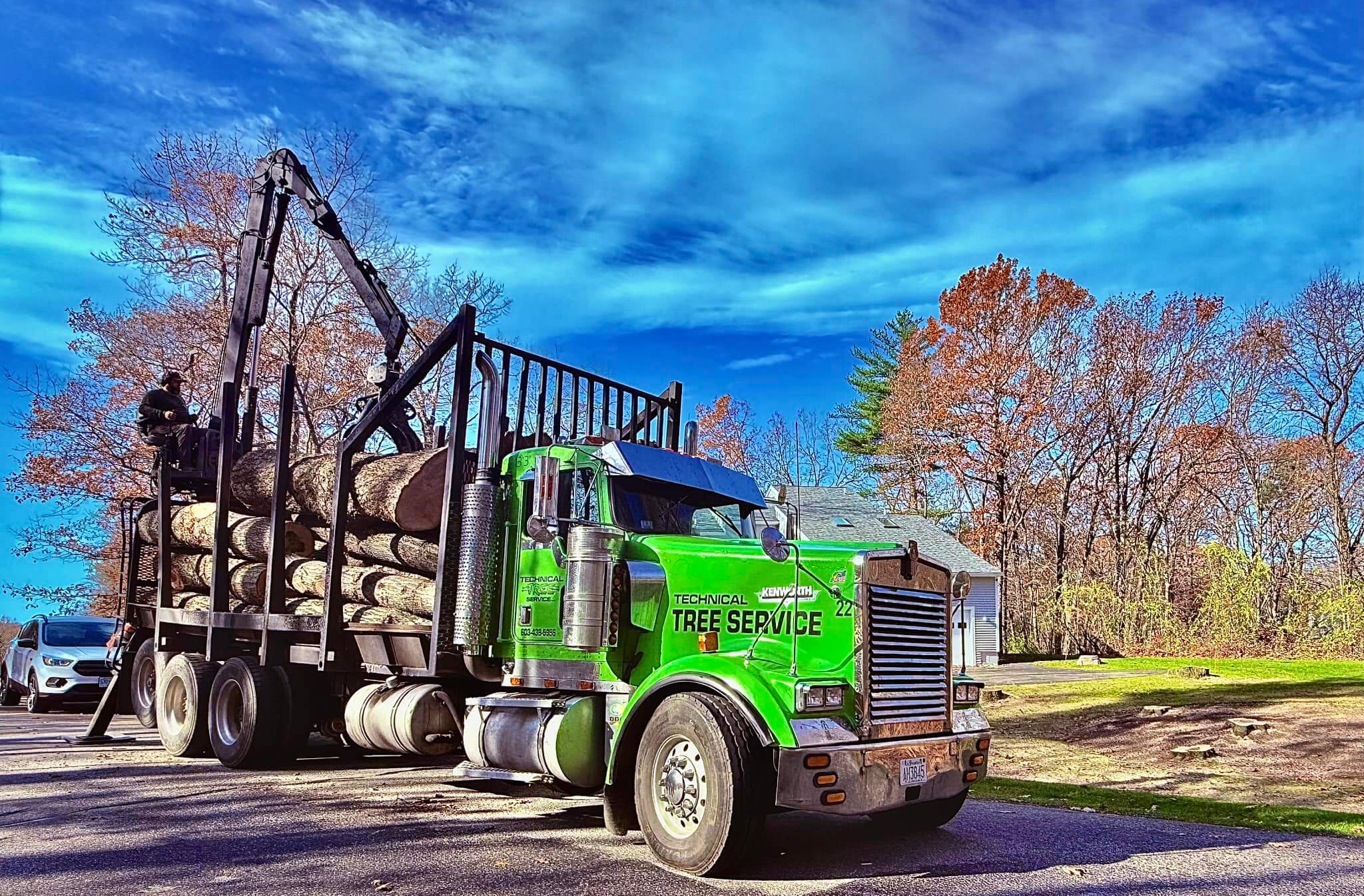
Technical Tree Service provides professional tree removal in Auburn, NH for dead trees, storm-damaged trees, dangerous leaners, large pines, trees growing close to homes, and removals where limited access changes how the job needs to be handled. Our team includes ISA Certified Arborists, we are fully insured, and we own cranes for removals that require controlled lifting.
For urgent hazards, our 24/7 emergency team provides response in Auburn within 1 hour. For planned work, we inspect the tree and property on site before pricing the job so the estimate reflects access, tree condition, nearby structures, cleanup requirements, and the removal method that makes sense for the property.
Auburn has a mix of wooded residential lots, mature roadside trees, lake and watershed properties, and homes where trees stand close to roofs, driveways, utility lines, or neighboring property. A removal plan that works in an open field may make little sense on a tight lot near Route 121, Eaton Hill Road, or the neighborhoods surrounding Lake Massabesic.
Tree Removal for Auburn Homes, Wooded Lots, and Tight Spaces
A tree may need to come down because it is dead, structurally compromised, declining, damaged in a storm, interfering with planned construction, or positioned where failure could hit a home or another occupied area.
The question is not simply how tall the tree is. Before a removal, the tree’s lean, trunk condition, major unions, canopy weight, root area, surrounding targets, equipment access, working space, and landing area all affect the plan.
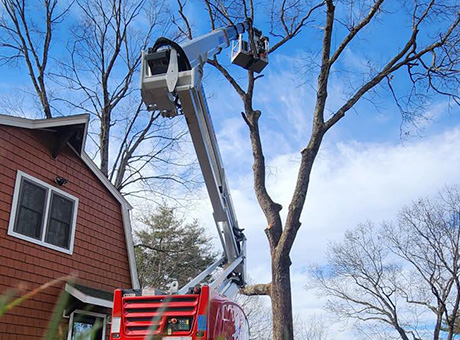
Technical Tree Service provides professional tree removal services for Auburn properties ranging from open residential lots to confined areas where sections have to be controlled from the tree to the ground.
Homes around Auburn Village School and Eaton Hill Road can present a different setup from heavily wooded properties farther from the village center. Properties near Lake Massabesic can add another issue: watershed and shoreland rules may need to be considered before vegetation is removed.
Common Tree Hazards in Auburn Neighborhoods
Some hazards are obvious. A tree is on the roof, a trunk has split, or a large limb is hanging over the driveway. Other problems are easier to miss until wind, snow, or saturated soil puts more load on an already weakened tree.
Conditions that deserve a closer look include newly exposed roots, soil lifting around the root plate, cracks extending into a main union, cavities in the trunk, large dead limbs, recent changes in lean, broken tops, and sections of canopy that died back unexpectedly.
Storm history matters too. A tree that remained standing after a Nor’easter may still have damaged limbs or roots. If another tree recently fell beside it, the remaining tree may also have lost wind protection that it had for years.
White pine deserves particular attention after strong wind events. New Hampshire forestry guidance identifies white pine as more susceptible to wind damage than many northern hardwoods. That does not mean a large pine automatically needs removal. Its condition, root support, exposure, defects, and targets around it matter more than the species name alone.
White Pine, Red Oak, and Sugar Maple on Auburn Properties
White pine, red oak, and sugar maple are familiar parts of the Southern New Hampshire landscape, but they do not fail in the same ways or for the same reasons.
White pines can develop significant height and wind exposure, especially when neighboring trees are removed and the remaining canopy becomes more exposed. Oaks can retain large dead limbs or develop decay around old wounds and branch unions. Maples may show structural problems where multiple stems or heavy limbs join the trunk.
Pests and disease can add another layer. Bark beetles, wood borers, fungal infections, and root problems occur in New Hampshire trees, but seeing an insect hole or mushroom does not by itself prove a tree needs removal.
Our ISA Certified Arborists can separate a condition that calls for removal from one that may be handled with pruning, monitoring, or other tree care. Species is part of that decision, not the whole decision.
24/7 Emergency Tree Removal in Auburn With Response Within 1 Hour
A tree on a house cannot be approached like a routine removal scheduled weeks in advance. The same applies to a hanging leader over an entrance, a split trunk that is still moving, a tree blocking the driveway, or a root plate that lifted during a storm.
Technical Tree Service provides 24/7 emergency tree service in Auburn with response within 1 hour for emergency calls.
If multiple trees and debris are down after high wind, snow, or ice, our storm damage cleanup service can address fallen material and remaining hazards around the property.
Until the site has been evaluated, stay away from suspended limbs, split trunks, uprooted trees under tension, and any tree in contact with electrical conductors. A limb that looks stable from the ground can move when another section is cut or when wind loads change.
What to Do if a Tree Falls on Your House in Auburn
People come first. Keep family members and pets away from the damaged area and do not walk beneath broken sections of the tree. If electrical lines are involved, do not approach the tree or attempt to move branches away from the wires.
Once the immediate area is safe, photograph the damage from a safe location before cleanup changes the scene. Contact your homeowners insurance carrier and ask what documentation they want for the claim. Keep estimates, invoices, photographs, and any instructions from the adjuster.
Homeowners insurance may cover tree-related damage when a covered event, such as wind, causes a tree to strike an insured structure. Coverage for the removal itself depends on the policy, what caused the failure, and what the tree damaged. A tree that simply falls in an open section of the yard is treated differently by many policies.
Preventive removal of a declining tree is generally considered property maintenance rather than a storm claim. If you are unsure, ask your insurer before assuming the removal will be reimbursed.
Protecting Your Lawn, Driveway, and Landscaping During Removal
The tree is only one part of the work area. A crew also needs to account for the house, driveway, septic areas, fences, gardens, vehicles, neighboring property, overhead lines, underground features, and the path equipment will use to enter and leave.
Ground conditions can change the plan. Auburn soil after rain or spring thaw may support equipment differently than frozen winter ground. A driveway may offer the best equipment position on one property while another site requires a setup farther from the tree.
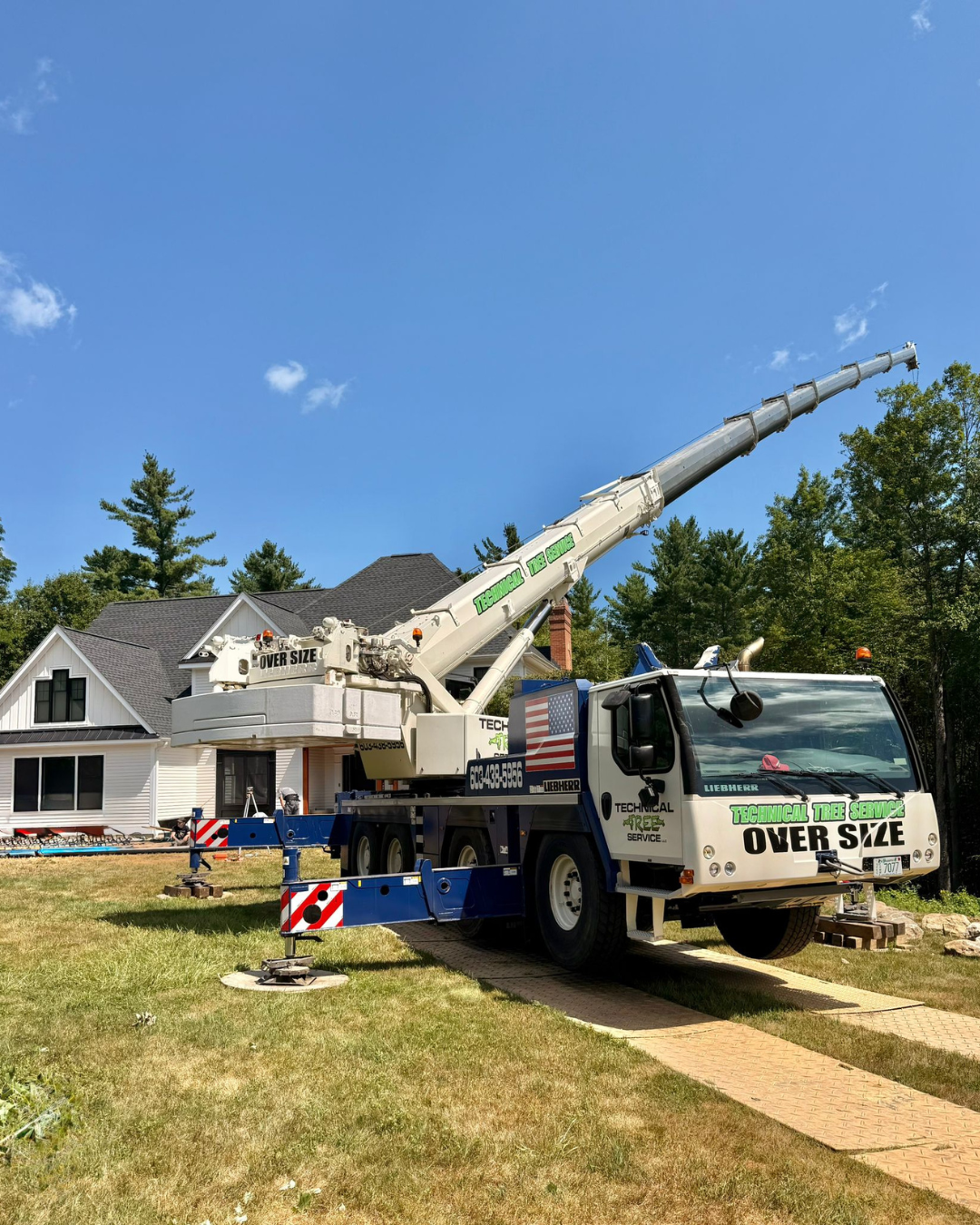
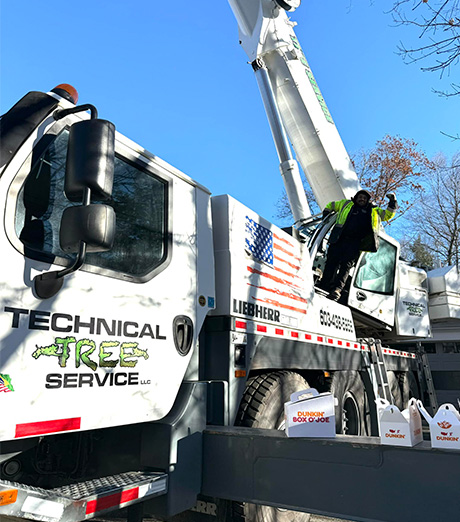
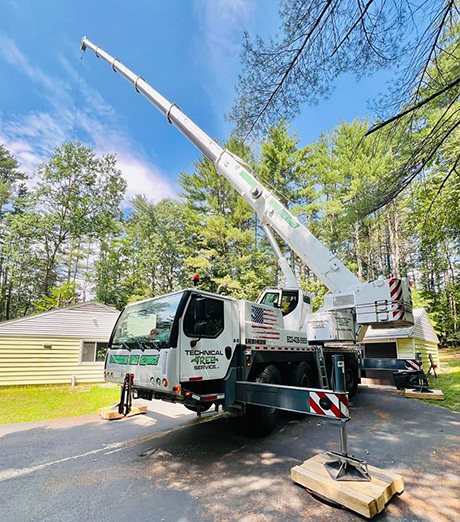
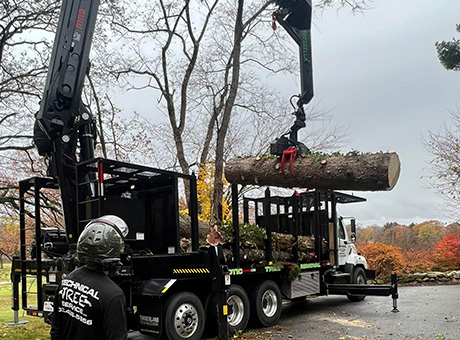
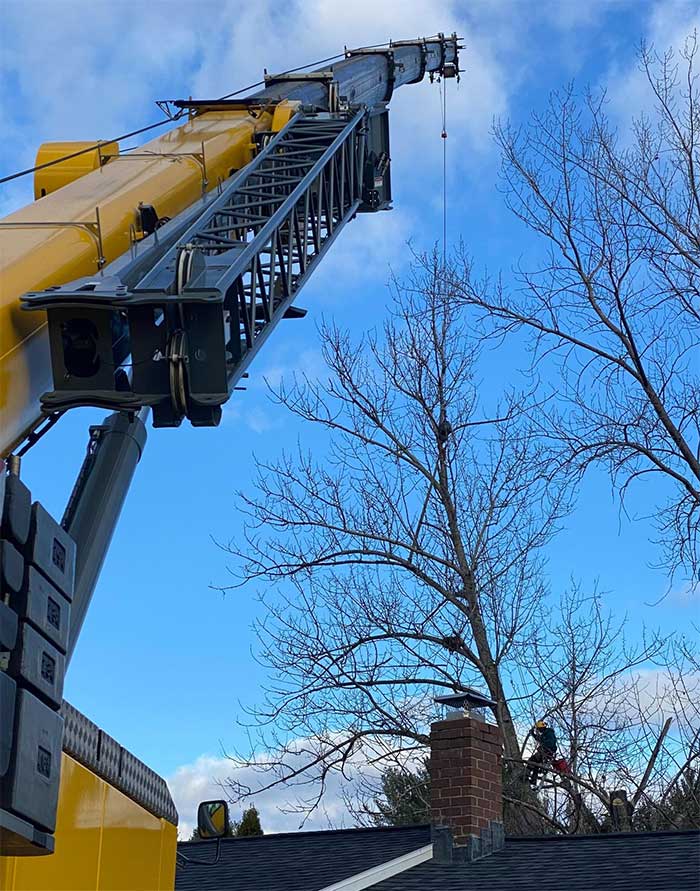
For large trees beside structures or sites with limited landing room, crane-assisted work can allow sections to be lifted and transferred to a controlled processing area. Technical Tree Service owns its cranes and can use crane support when the tree and property call for it.
A crane is not automatically the right answer for every tree. Open space, tree condition, access, lift geometry, ground conditions, and surrounding targets are considered before choosing the removal method.
Trees Near Power Lines in Auburn
A tree close to electrical lines changes who should handle the first part of the job. Property owners should not cut, pull, or climb a tree that could contact an energized conductor.
Eversource distinguishes between vegetation around its distribution system and the service wire running from a utility pole to a home. If branches are directly rubbing against a service wire, Eversource advises customers to contact the utility. When a professional tree contractor needs access around that service drop, the utility may be able to temporarily disconnect the line so work can proceed safely.
For branches that need maintenance rather than whole-tree removal, professional tree trimming may be the better solution once electrical clearance and responsibility have been determined.
If a storm has brought a tree into active power lines, stay clear and contact the utility or emergency services first. Do not assume a line is safe because the power appears to be out.
Do You Need a Permit to Remove a Tree in Auburn NH?
There is no useful one-word answer for every Auburn property. A routine tree removal on a residential lot and tree cutting inside a protected watershed, wetland, shoreland, scenic-road, or regulated area can be subject to different rules.
Auburn’s published zoning regulations contain specific restrictions within the Wetlands and Watershed Protection Area. Cutting or removing living trees and shrubs in that regulated area can require a minor conditional use permit, with an exception for work needed to prevent imminent personal injury or property damage. Planning Board review and consultation with the Auburn Conservation Commission can be part of that process.
Properties near Lake Massabesic deserve extra attention. New Hampshire’s Shoreland Water Quality Protection Act limits vegetation removal within protected shoreland. Within the waterfront buffer, tree and sapling removal is controlled, and stumps and root systems generally need to remain unless the applicable rules or approvals allow otherwise.
This means a homeowner should not assume that owning the tree automatically removes every land-use restriction. If the property is near Lake Massabesic, a wetland, a protected buffer, or another regulated area, confirm the parcel requirements before non-emergency cutting begins.
For an ordinary private residential removal where no special district or regulated feature is involved, the situation may be much simpler. Auburn’s Zoning Department can confirm municipal requirements for a specific parcel when there is doubt.
Tree Removal Costs in Auburn: What Changes the Estimate?
There is no standard Auburn tree removal price that can be calculated from height alone. Two 40-foot trees can require completely different amounts of labor, equipment, rigging, and cleanup.
An open-grown tree with clear access and room to work may be straightforward. A tree of similar height leaning over a home, wrapped around utility lines, damaged at the base, or located behind limited access can require a different removal plan.
The estimate can be affected by trunk diameter, tree condition, number and spread of major limbs, proximity to structures, crane access, equipment setup, material handling, debris removal, and whether stump work is included.
That is also why there is no reliable rule such as “a tree of this size costs $1,000.” Pricing a removal before understanding where the tree stands leaves out the part of the job that often matters most.
Technical Tree Service provides a free on-site estimate so the tree and property can be evaluated before a price is given.
Does Stump Grinding Need to Be Done at the Same Time?
Removing the tree and dealing with the stump are separate parts of the project. Some property owners want the stump left in place. Others need the area available for lawn, landscaping, access, or another project.
Stump grinding can reduce the remaining stump below surrounding grade and remove the obstacle from the usable surface of the yard.
Near protected shoreland, the rules can be different. New Hampshire shoreland standards generally require stumps and root systems within the waterfront buffer to remain unless removal is specifically allowed. That distinction matters on properties close to qualifying waters.
If the stump is near Lake Massabesic or another protected waterbody, confirm the site restrictions before assuming grinding or excavation should follow the tree removal automatically.
Seasonal Tree Removal in Southern New Hampshire
Auburn tree work does not stop when winter arrives. The better season depends on why the tree needs work and what the property looks like at that time.
Frozen ground can sometimes make equipment access easier on soft portions of a property. Snow and ice can create their own access problems. Spring thaw can leave saturated ground that changes where heavy equipment can travel. Summer provides full-canopy conditions for evaluating foliage but also brings thunderstorms and periods of high demand after storm events.
There is no month that is automatically the cheapest time to remove every tree. A planned removal with flexible scheduling may have more options than an emergency job, but the tree’s condition and the site still control how the work has to be performed.
If a tree has an active structural defect or is threatening an occupied area, waiting for a supposedly cheaper season can create a larger problem.
How ISA Certified Arborists Evaluate a Removal Decision
A tree can look unhealthy and still be manageable. Another can carry a serious structural defect while keeping a full green canopy. That is one reason removal decisions should not be based on appearance alone.
Our ISA Certified Arborists consider tree condition, defects, root support, targets, species characteristics, recent site changes, storm damage, and the consequences if part or all of the tree fails.
ISA certification is a professional arboriculture credential and should not be confused with separate New Hampshire occupational licenses, such as forester or landscape architect licensing. The useful question for a homeowner is who is evaluating the tree, what qualification that person holds, and what observed condition supports the recommendation.
If pruning can address the concern, removal should not be presented as the automatic answer. If the structure of the tree has deteriorated beyond a reasonable management option, the removal plan then needs to address how the tree can be taken down around the property safely.
Tree Removal Near Lake Massabesic
Lake Massabesic is part of what makes Auburn’s tree-removal conditions different from a generic suburban service area. The lake is also part of Manchester’s public water supply, and much of Auburn lies within its watershed.
A property near the lake can have mature vegetation that contributes to slope stability, runoff control, shoreline protection, and the wooded character of the area. Removing a hazardous tree and clearing healthy vegetation are not treated as the same activity under shoreland rules.
For dead, diseased, or unsafe vegetation within regulated shoreland, New Hampshire rules provide a path for removal while requiring protection of surrounding vegetation and soil. Documentation can matter. State rules identify photographs and written certification by a qualified professional, such as a certified arborist, among the evidence that can support the condition of removed vegetation.
If your Auburn property is close to Lake Massabesic, determine the regulatory boundary before planning broad clearing, stump excavation, or removal of healthy trees.
Tree Removal in Auburn and Nearby Southern NH Communities
Technical Tree Service serves Auburn and communities throughout Southern New Hampshire. Auburn’s location puts many customers close to the same storm systems and tree conditions seen in neighboring parts of Rockingham, Hillsborough, and Merrimack Counties.
Property owners looking for service west of Auburn can also review our tree service in Manchester, NH. To the south, we also provide tree service in Derry, NH.
If you are outside Auburn and do not see your town listed, contact the office to confirm current coverage for your address.
Why Auburn Property Owners Call Technical Tree Service
- More than 25 years of tree care and removal experience
- ISA Certified Arborists
- Fully insured tree service company
- Member of the Tree Care Industry Association
- Company-owned cranes for removals that require controlled lifting
- 24/7 emergency tree service
- Emergency response in Auburn within 1 hour
- Free on-site estimates before planned work
Tree Removal Auburn NH FAQs
How much does tree removal typically cost in Auburn, NH?
Tree removal does not have one standard price. Height, trunk size, condition, access, proximity to homes and utilities, equipment needs, debris handling, and stump work can all change the estimate. Technical Tree Service inspects the property before providing pricing.
How much does it cost to cut down a 40-foot tree?
Height by itself is not enough to price the job. A 40-foot tree in an open yard may require a simpler setup than a tree of the same height over a roof or behind restricted access. An on-site evaluation is needed for a meaningful estimate.
Do I need a permit to remove a tree on my Auburn property?
Many ordinary residential removals may not involve a special tree permit, but regulated properties can be different. Auburn’s Wetlands and Watershed Protection Area has restrictions on cutting living vegetation, and New Hampshire shoreland rules can apply near protected waters such as Lake Massabesic. Check the parcel before cutting when a regulated area may be involved.
How quickly can Technical Tree Service respond to an emergency in Auburn?
Technical Tree Service provides 24/7 emergency tree service in Auburn with response within 1 hour for emergency calls.
What should I do if a tree falls on my house?
Keep people away from the affected area, stay clear of damaged limbs and electrical lines, and contact emergency services or the utility when required. Photograph the damage from a safe location and contact your homeowners insurance carrier about its claim requirements.
Will homeowners insurance pay for tree removal?
It depends on the policy, the cause of the tree failure, and what was damaged. Policies may cover removal when a covered event causes a tree to damage an insured structure. Preventive removal and a tree that falls harmlessly in an open yard are often treated differently. Confirm coverage with your insurer.
What Auburn tree species are vulnerable to storm damage?
White pine can be vulnerable to high winds, while mature oaks, maples, and other species can develop their own structural defects or storm damage. Species alone does not determine whether removal is needed. Root condition, defects, exposure, canopy structure, and nearby targets should also be evaluated.
Can you remove a tree near power lines?
Tree work around electrical conductors requires added planning and may require coordination with the utility. Do not approach a tree contacting an energized line. Eversource can provide guidance on vegetation near its lines and on service wires running from the pole to a residence.
Does a large tree automatically need crane-assisted removal?
No. Crane use depends on access, tree condition, available working space, surrounding structures, lift geometry, and how material can be moved through the property. Technical Tree Service owns cranes and uses them where the site and removal plan warrant it.
What is the best time of year to remove a tree in Auburn?
There is no single best month for every property. Winter may provide firmer frozen ground on some sites, while snow and ice may affect access. Spring can bring saturated soil. Hazardous or storm-damaged trees may need work regardless of season.
Request a Tree Removal Estimate in Auburn NH
If you have a dead tree, storm damage, a large pine near your home, a questionable lean, limbs over the roof, or a tree that needs to be evaluated before removal, schedule an on-site assessment with Technical Tree Service.
For planned work, we can inspect the tree and site before providing your estimate. If a tree is creating an immediate hazard, our emergency service is available 24/7 with response in Auburn within 1 hour.
Call (603) 438-5956 to schedule tree removal service in Auburn, NH.