Tree Removal in Hudson NH
Technical Tree Service provides professional tree removal in Hudson, NH for dead trees, storm-damaged trees, dangerous leaners, large white pines, trees growing close to homes, and removals where limited access changes how the work needs to be handled. Our team includes ISA Certified Arborists, we are fully insured, and we own cranes for projects that require controlled lifting.
For an immediate tree hazard, our 24/7 emergency service provides response in Hudson within 1 hour. Planned removals begin with an on-site evaluation because tree height alone does not tell us what the job will involve. Tree condition, access, nearby structures, electrical lines, available working space, debris handling, and stump work can all change the scope.
Hudson combines established residential neighborhoods, wooded lots, commercial corridors, wetlands, and properties along or near the Merrimack River. Those conditions create very different tree-removal situations within the same town.
Tree Removal for Hudson Homes and Wooded Properties
A tree may need removal after storm damage, significant decline, root failure, trunk decay, a structural defect, construction changes, or because its location creates an unacceptable risk to a house, driveway, garage, utility line, or another occupied area.
Technical Tree Service provides professional tree removal throughout Hudson. The removal method depends on what is around the tree as much as the tree itself.
An open-grown tree with room around it may offer several workable options. A tree behind a house, over a roof, beside a septic area, close to electrical conductors, or surrounded by landscaping can require a much more controlled plan.
The goal of the site assessment is to answer practical questions before cutting begins: Where can equipment safely operate? What is underneath the canopy? Which sections can be moved freely? Where can wood be processed? Is part of the tree under tension? Are there defects that change how a limb or trunk section may react once weight is removed?
Common Tree Hazards on Hudson Properties
A fallen tree is easy to recognize as a problem. The more difficult situations are trees that are still standing but have changed after a storm or over several seasons.
Warning conditions can include a newly developed lean, soil lifting around the root plate, cracks at major branch unions, large dead limbs, cavities, broken tops, exposed or damaged roots, sections of canopy dying back, or branches hanging after wind or snow.
The location of the defect matters. A dead limb high in a tree over an unused wooded area presents a different decision from the same limb over a driveway, deck, play area, or front entrance.
Hudson’s mix of mature trees and suburban development means those targets are often close together. That is why an ISA Certified Arborist looks at both the tree and what could be affected if part of it fails.
White Pine, Oak, Maple, Hemlock, and Ash in Hudson
Hudson properties commonly contain white pine, oak, maple, birch, hemlock, and other New Hampshire species. Different species bring different structural patterns, storm responses, and pest concerns.
White pine deserves attention after strong wind. New Hampshire forestry guidance identifies white pine as especially susceptible to wind damage compared with many northern hardwoods. Exposure, soil moisture, tree age, stand density, and recent clearing around a tree can all affect that risk.
A pine that has stood for decades does not automatically become dangerous because of its species. The question is whether the individual tree has root movement, trunk damage, broken leaders, decay, unusual lean, or a new exposure pattern that changes the likelihood or consequence of failure.
Mature oaks and maples can develop large dead limbs, decay around old wounds, or weak unions. Hemlocks face their own pest and health pressures. Ash trees deserve particular attention because emerald ash borer remains present in New Hampshire and can lead to severe decline.
A declining tree does not automatically need removal. An arborist assessment can distinguish situations where removal makes sense from cases where pruning, monitoring, or other care remains reasonable.
24/7 Emergency Tree Removal in Hudson With Response Within 1 Hour
A tree on a house, a split trunk still standing over a driveway, an uprooted tree leaning into another tree, or a large suspended limb cannot be handled like routine maintenance.
Technical Tree Service provides 24/7 emergency tree service in Hudson with response within 1 hour for emergency calls.
After heavy wind, wet snow, ice, or another damaging event, the visible fallen tree may not be the only hazard. Adjacent trees can have broken tops, loaded limbs, disturbed roots, or new openings that leave them more exposed to wind.
For properties with widespread debris or multiple damaged trees, our storm damage cleanup service addresses fallen material along with the remaining tree hazards that need attention.
Do not stand under suspended limbs or attempt to pull down storm-damaged sections with a vehicle, rope, or residential equipment. Wood under tension can move in a direction that is difficult to predict once it is cut or released.
What Should You Do if a Tree Falls on Your Hudson Home?
Keep people and pets out of the affected part of the property first. If a tree or branch is in contact with an electrical line, do not approach it. A downed conductor can remain energized even when there are no sparks or visible signs of power.
Once you can do so from a safe location, photograph the tree and property damage before cleanup changes the scene. Contact your homeowners insurance company and ask what documentation it wants for the claim.
Save photographs, estimates, invoices, and communication related to the emergency work. Insurance coverage varies according to the policy, the event that caused the failure, and what the tree damaged.
A storm-damaged tree that strikes an insured structure can be treated differently from a tree that falls into an open part of the yard. Preventive removal of a declining tree is also different from emergency removal following a covered weather event.
Do not assume either that insurance will pay everything or that nothing is covered. The carrier needs to determine that from the policy and the circumstances of the loss.
How We Approach Large Trees Near Houses and Driveways
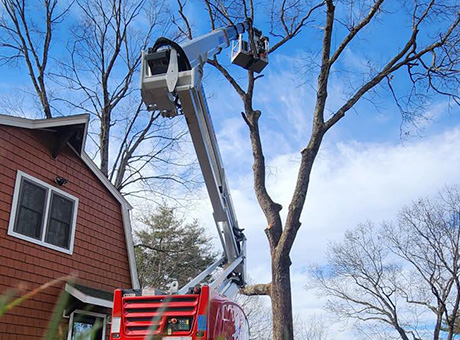
Large trees do not always have an open area where they can be felled in one piece. Hudson properties can have roofs, garages, sheds, paved driveways, fencing, landscaping, utilities, neighboring lots, and other trees within the working area.
In those situations, sections of the tree may need to be controlled individually rather than allowed to fall freely.
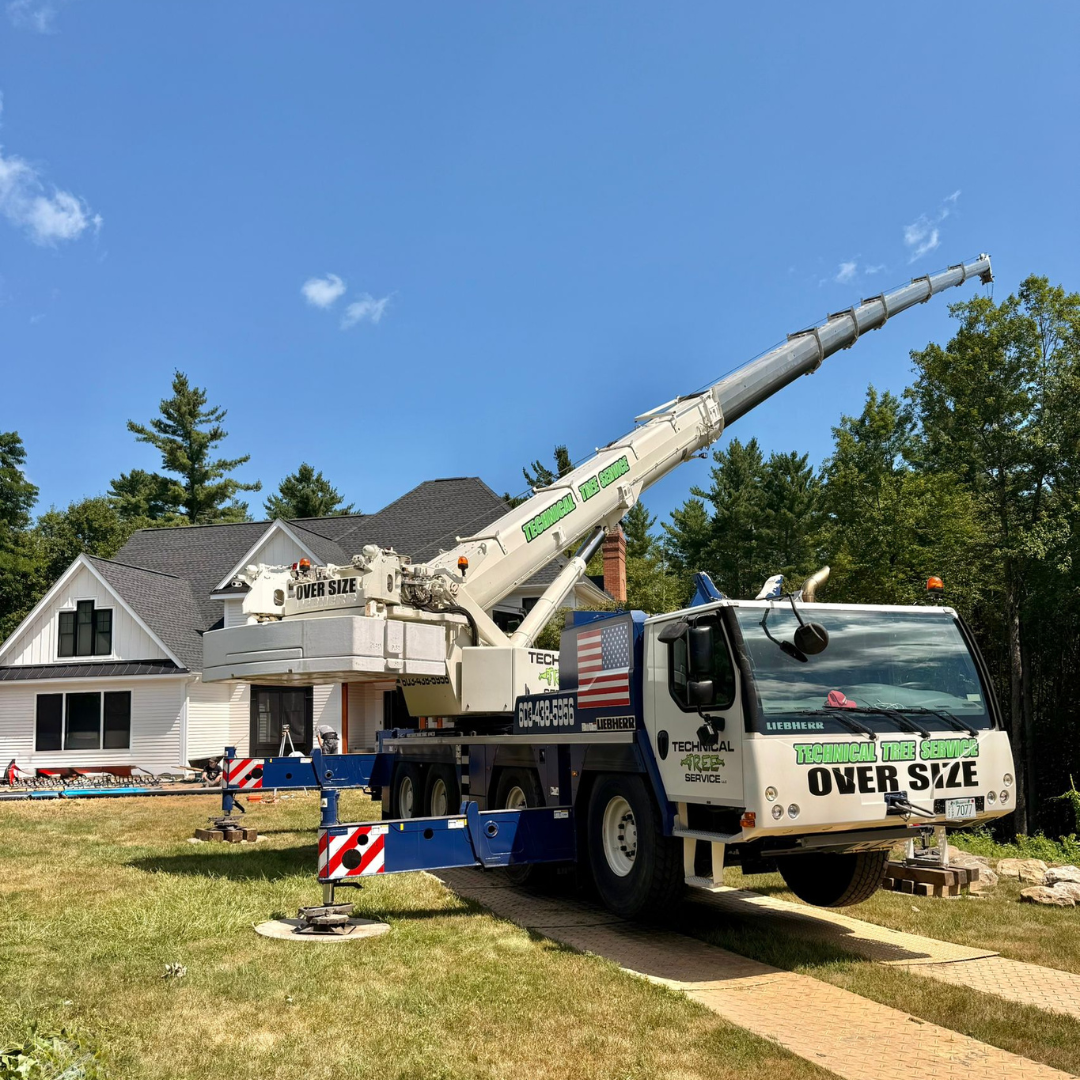
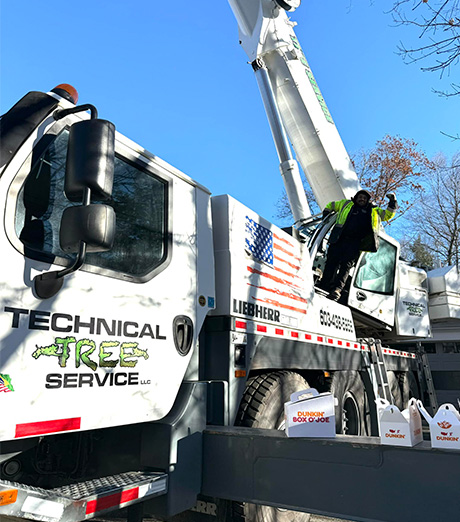
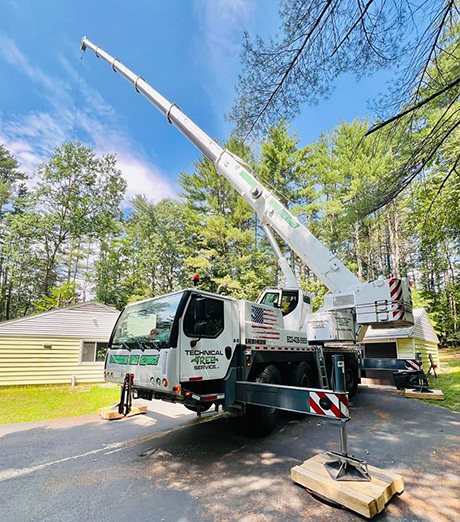
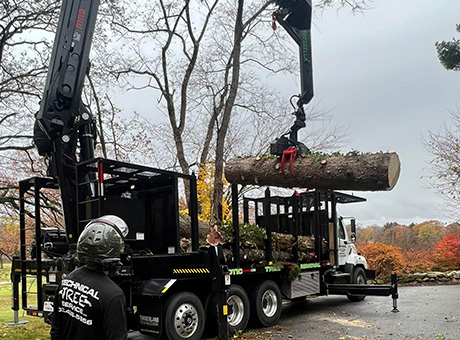
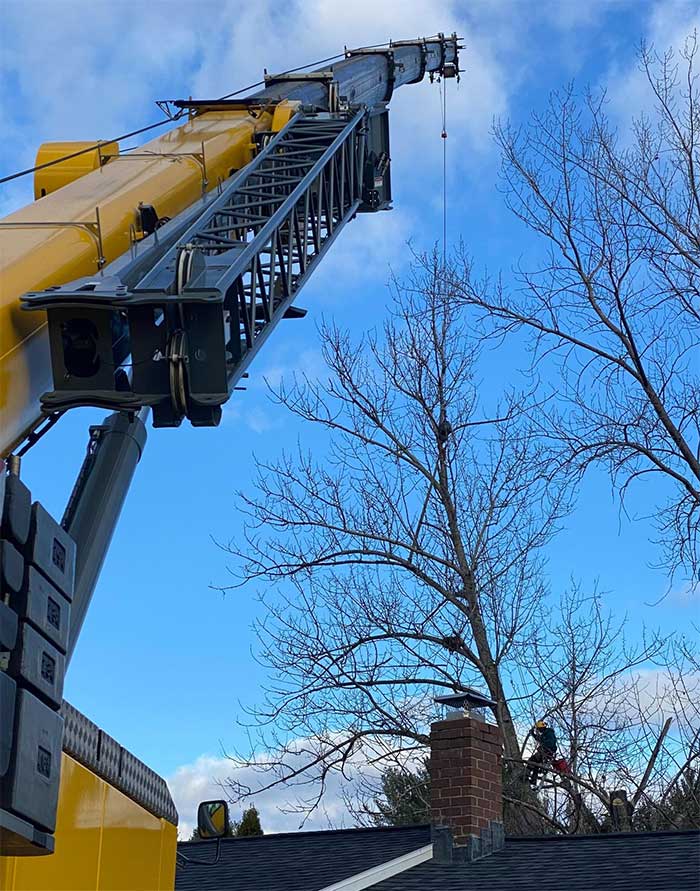
Technical Tree Service owns cranes and can use crane support for tree removal when the site and tree call for controlled lifting. The ability to use a crane does not mean every tree should be removed that way.
The choice depends on access, tree condition, working radius, surrounding structures, ground conditions, available landing space, and how individual sections can be moved out of the canopy.
Rigging and roping can also be used to control material where free dropping is inappropriate. What matters is matching the method to the actual geometry and condition of the site.
Protecting Lawns, Driveways, and Landscaping During Tree Removal
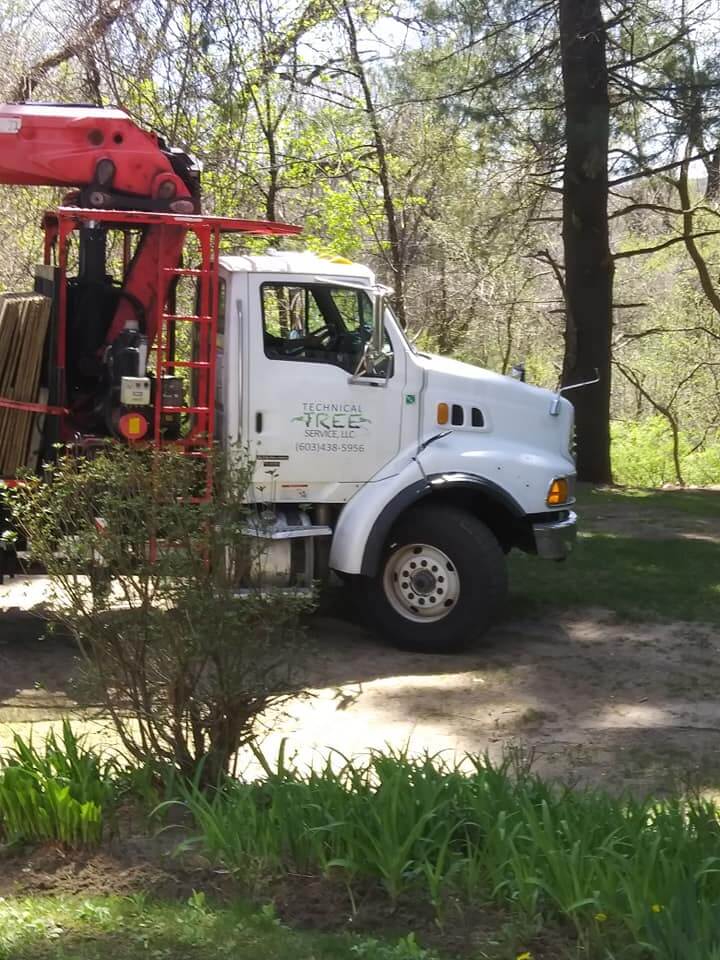
Removing the tree is only part of planning the work area. The crew also needs to consider how equipment gets to the tree, where branches and wood can be processed, and what parts of the property need to remain outside the active work zone.
A lawn after several days of rain does not behave like frozen ground in January. A paved driveway may provide useful equipment access on one property but place equipment at the wrong angle on another.
Landscaping beneath the canopy also changes the plan. Flower beds, shrubs, fencing, stonework, septic components, vehicles, and neighboring property can reduce the amount of space available for handling branches and trunk sections.
This is another reason a meaningful quote requires seeing the property rather than pricing the tree from a photograph or a height estimate alone.
Trees Near Power Lines in Hudson
Tree removal around electrical conductors requires added coordination. Homeowners should not cut, climb, pull, or attempt to rig a tree that is touching a power line or could move into an energized conductor.
Eversource distinguishes between vegetation along its distribution system and branches around the service wire running from a utility pole to a house. The utility advises customers to contact it when branches are applying pressure to a service wire.
For professional tree work near a pole-to-house service wire, Eversource may temporarily remove the service connection so a tree contractor can complete the work safely.
If the concern is branch clearance rather than whole-tree removal, tree trimming and pruning may be the appropriate service once responsibility for the electrical clearance has been established.
If a storm has brought a tree onto active lines, stay clear and contact the utility or emergency services before approaching the tree.
Do You Need a Permit to Remove a Tree in Hudson NH?
A routine residential tree removal and a timber harvest are not always treated the same way under New Hampshire law, and the location of the tree on the parcel can create additional requirements.
Intent to Cut and Timber Tax
Hudson’s Assessing Department administers New Hampshire’s Notice of Intent to Cut requirements for timber-cutting operations. A PA-7 Notice of Intent to Cut may be required before taxable timber harvesting begins.
That does not mean every backyard tree requires a timber-cutting filing. New Hampshire’s timber tax guidance lists several exemptions, including shade and ornamental trees, which it describes as trees usually located within striking distance of a building.
A homeowner removing one hazardous yard tree is therefore in a different situation from a landowner conducting a timber harvest or clearing substantial forest acreage.
Wetlands and Surface-Water Buffers
Location matters in Hudson. The town’s Wetlands Conservation Overlay District covers wetlands and surface waters along with a 50-foot buffer for residential uses and a 75-foot buffer for nonresidential uses.
Removal of vegetation within that district falls under Hudson’s wetland regulations. Some activities require review by the Conservation Commission, Planning Board, or other agencies depending on what is proposed.
If a tree is close to a wetland, pond, stream, or another surface-water feature, do not assume ordinary yard rules apply. Hudson’s Land Use or Zoning staff at Town Hall can confirm which municipal rules affect the parcel.
The same caution applies to larger clearing projects. Tree removal, timber harvesting, grading, stump excavation, and construction can trigger different rules even when they happen on the same property.
How Much Does Tree Removal Cost in Hudson NH?
There is no honest standard price for a Hudson tree based only on height. A 40-foot tree can be a straightforward removal or a technical project depending on where it stands and what condition it is in.
A tree with open access and room around the canopy can require a different setup from a tree of the same height behind a house, beside power lines, over a garage, or growing from an area where equipment cannot easily reach it.
Factors that can change the estimate include:
- Tree height and trunk diameter
- Condition of the trunk, roots, and canopy
- Distance from homes, garages, fences, and utilities
- Available equipment access
- Amount of rigging or controlled lifting required
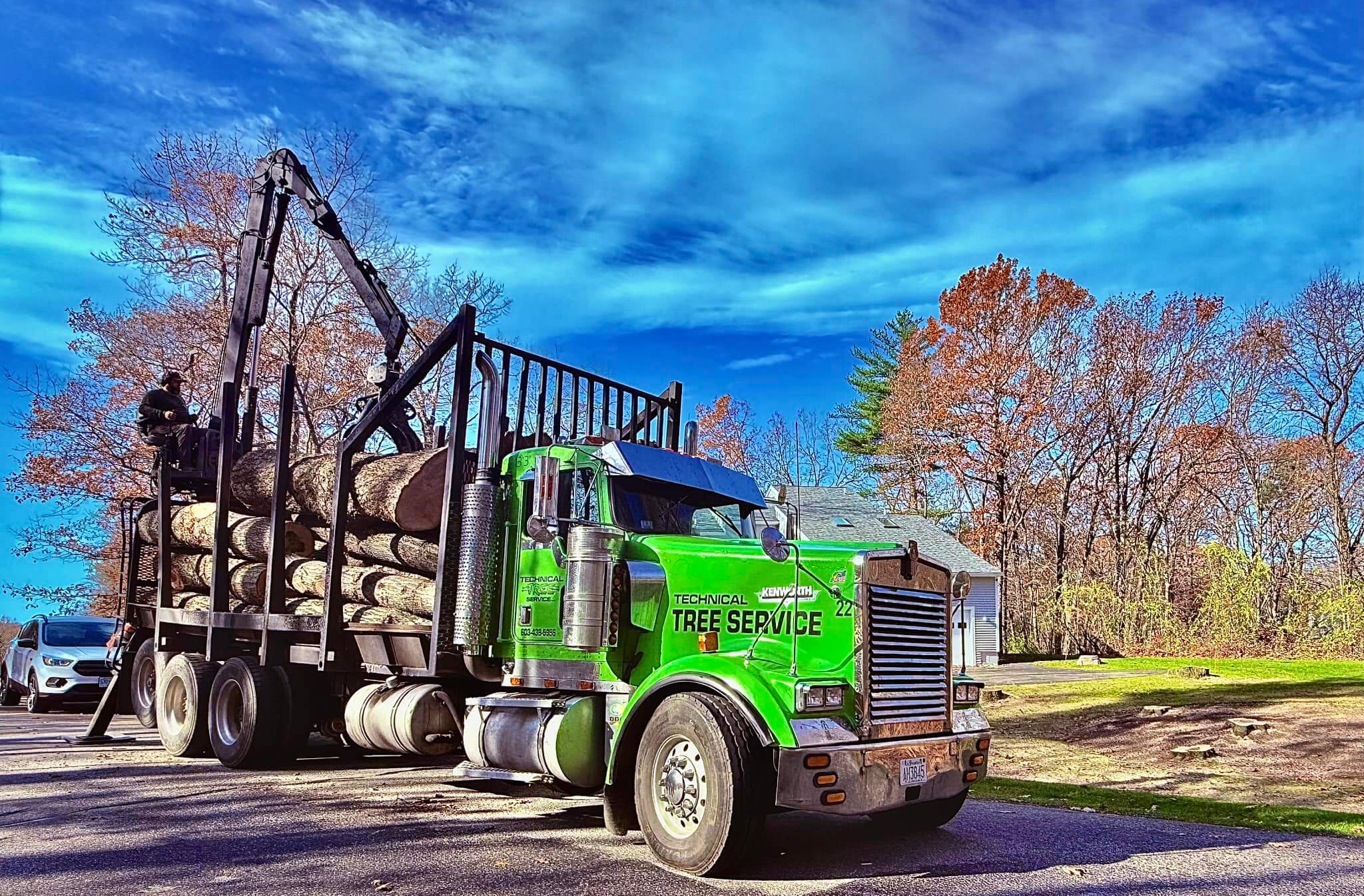
- Volume of wood and debris to be handled
- Whether stump grinding is included
That is why Technical Tree Service does not assign a meaningful tree-removal price without inspecting the property. We provide a free on-site estimate based on the actual tree and working conditions.
Comparing Tree Removal Quotes in Hudson
The lowest number on a quote is not useful until you know what that number includes.
One estimate might cover tree removal and debris handling while another excludes the stump. One may assume open access while another accounts for controlled rigging around a house. Equipment, cleanup scope, insurance, and how the tree will be handled can differ between proposals.
When comparing Hudson tree companies, ask the same questions of each contractor:
- Is the company fully insured for tree work?
- Who evaluates structural or health concerns?
- Does the quoted scope include debris cleanup?
- Is stump grinding included or priced separately?
- How will the tree be handled around structures and utilities?
- Does the company own the equipment proposed for the job?
- Who should you contact if conditions change after a storm?
Technical Tree Service is fully insured, has ISA Certified Arborists, owns its cranes, provides 24/7 emergency service, and has more than 25 years of tree-care and removal experience.
Stump Grinding After a Hudson Tree Removal
The stump does not automatically disappear when the tree is removed. Some property owners are comfortable leaving it. Others need the area available for lawn, landscaping, construction, or normal movement through the yard.
Stump grinding reduces the remaining stump below the surrounding surface instead of excavating the entire root system.
How the area will be used afterward should influence the decision. Preparing for grass requires a different discussion from preparing for a structure, utility work, or major regrading.
If the tree is located within a regulated wetland or surface-water buffer, confirm the applicable rules before disturbing the stump or soil. The regulations affecting removal of the standing tree and disturbance of the ground are not always identical.
What Is the Best Time of Year to Remove a Tree in Hudson?
Tree removal can be performed throughout the year when site and weather conditions allow. There is no single month that produces the same advantage on every property.
Frozen winter ground can sometimes support equipment differently from wet spring soil. Snow can make access harder. Spring thaw may leave portions of a yard saturated. Summer provides full-canopy conditions but can also bring thunderstorms and emergency demand.
A planned healthy-tree removal with flexible timing gives a homeowner more scheduling options than a cracked, uprooted, or storm-damaged tree.
If the tree presents an active risk to a house or occupied area, waiting several months simply to chase a theoretically cheaper season may not make sense.
Does Removing a Tree Hurt Property Value?
Removing a tree does not have one automatic effect on property value. A healthy mature shade tree can contribute to the character of a property. A dead tree beside a house creates a different situation.
The decision should consider why the tree is being removed, what it contributes to the property, what risk it creates, and what the site will look like afterward.
If a healthy tree is causing a manageable clearance or branch issue, removal may not be the first option. Pruning or another tree-care recommendation may preserve the tree while addressing the specific concern.
If the tree is structurally compromised or positioned where failure carries serious consequences, the value of keeping it needs to be weighed against that risk.
When an Arborist Assessment Makes Sense Before Removal
Green leaves do not prove that a tree is structurally sound, and dead branches do not automatically mean the entire tree is lost.
Our ISA Certified Arborists can evaluate the root area, trunk, major unions, canopy, visible decay, pests, storm damage, and nearby targets before a removal decision is made.
This distinction matters with trees affected by insects such as emerald ash borer. EAB attacks ash trees, but a suspicious hole in bark is not enough by itself to identify the insect or determine the remaining structural condition of the tree.
It also matters after storms. A tree can retain a green canopy while roots have shifted or a structural union has cracked.
The recommendation should follow what is found on the individual tree rather than starting with removal as the answer to every problem.
Tree Removal Across Hudson and Nearby Southern NH
Technical Tree Service works throughout Hudson, from established residential areas to wooded lots and properties close to the Merrimack River and other natural-resource areas.
For property owners who need pruning, assessments, stump work, or other services in addition to removal, see our broader tree service in Hudson, NH page.
We also serve surrounding Southern New Hampshire communities. Property owners immediately north of Hudson can review our tree service in Litchfield, NH page for local service information.
If you are outside Hudson or Litchfield, contact the office with your address and we can confirm current coverage.
Why Hudson Homeowners Choose Technical Tree Service
- More than 25 years of tree-care and removal experience
- ISA Certified Arborists
- Fully insured tree service company
- Member of the Tree Care Industry Association
- Company-owned cranes for projects that require controlled lifting
- 24/7 emergency tree service
- Emergency response in Hudson within 1 hour
- Free on-site estimates for planned tree work
Tree Removal Hudson NH FAQs
How much does tree removal cost in Hudson, NH?
There is no single tree-removal price that applies to every Hudson property. Tree size, condition, access, nearby structures and utilities, equipment requirements, debris handling, and stump work can all affect the estimate. Technical Tree Service provides pricing after an on-site evaluation.
How much does it cost to remove a 40-foot tree?
Height alone is not enough to price a removal. A 40-foot tree with open access may be very different from a tree of the same height over a roof, near electrical lines, or behind a home with limited equipment access.
Do I need a permit to remove a tree in Hudson?
It depends on the type and location of the work. New Hampshire timber-cutting operations may require a Notice of Intent to Cut, although shade and ornamental trees can qualify for exemptions. Hudson also regulates vegetation removal within its Wetlands Conservation Overlay District. Check with the town when wetlands, surface waters, substantial clearing, or timber harvesting may be involved.
Can I cut down a tree in my own backyard?
Property ownership does not remove every land-use or safety restriction. A normal yard tree can be different from a tree in a wetland buffer, protected area, utility corridor, or timber-cutting operation. The tree’s location should be checked when any regulated feature may be present.
How quickly can you respond to emergency tree damage in Hudson?
Technical Tree Service provides 24/7 emergency service with response in Hudson within 1 hour for emergency calls.
What tree species are common on Hudson properties?
Hudson properties commonly include oak, maple, white pine, birch, and hemlock. Ash trees are also found in New Hampshire and can be affected by emerald ash borer. The condition of the individual tree matters more than species alone when determining whether removal is needed.
Is white pine more likely to be damaged by wind?
White pine is relatively susceptible to wind damage according to New Hampshire forestry guidance. Exposure, wet or shallow soils, tree age, stand density, and changes to surrounding trees can also affect wind vulnerability.
Can you remove trees near power lines?
Tree work near electrical conductors requires careful coordination and may involve the utility. Do not approach a tree touching an energized line. For work around a pole-to-house service wire, Eversource may be able to temporarily disconnect the service so a professional contractor can work safely.
Is stump grinding included with tree removal?
Tree removal and stump grinding are separate parts of a project. The estimate should specify whether stump grinding is included so you can compare the same scope when reviewing quotes.
What is the cheapest month for tree removal?
There is no month that is automatically cheapest for every Hudson tree. Access, ground conditions, tree condition, equipment requirements, demand, and urgency have more influence on an individual job than a calendar rule.
Does removing a tree decrease property value?
It depends on the tree and why it is being removed. A healthy mature tree can add shade and character, while a dead, hazardous, or poorly positioned tree presents a different tradeoff. An arborist can help determine whether removal is warranted or another form of tree care makes more sense.
Request a Tree Removal Estimate in Hudson NH
If you have a dead tree, storm damage, a large pine close to your home, a questionable lean, limbs over a structure, or a tree that needs professional evaluation before removal, Technical Tree Service can inspect the site and determine what the work requires.
Planned tree removals receive a free on-site estimate. For an immediate hazard, our emergency service is available 24/7 with response in Hudson within 1 hour.
Call (603) 438-5956 to schedule tree removal in Hudson, NH.