Manchester, NH is New Hampshire’s largest city, with dense residential neighborhoods, older homes, commercial corridors, parks and properties along the Merrimack River valley. Trees that fit comfortably on a wooded lot can become harder to manage in an urban setting where roofs, driveways, sidewalks, parked vehicles, utility lines and neighboring property are close to the canopy.
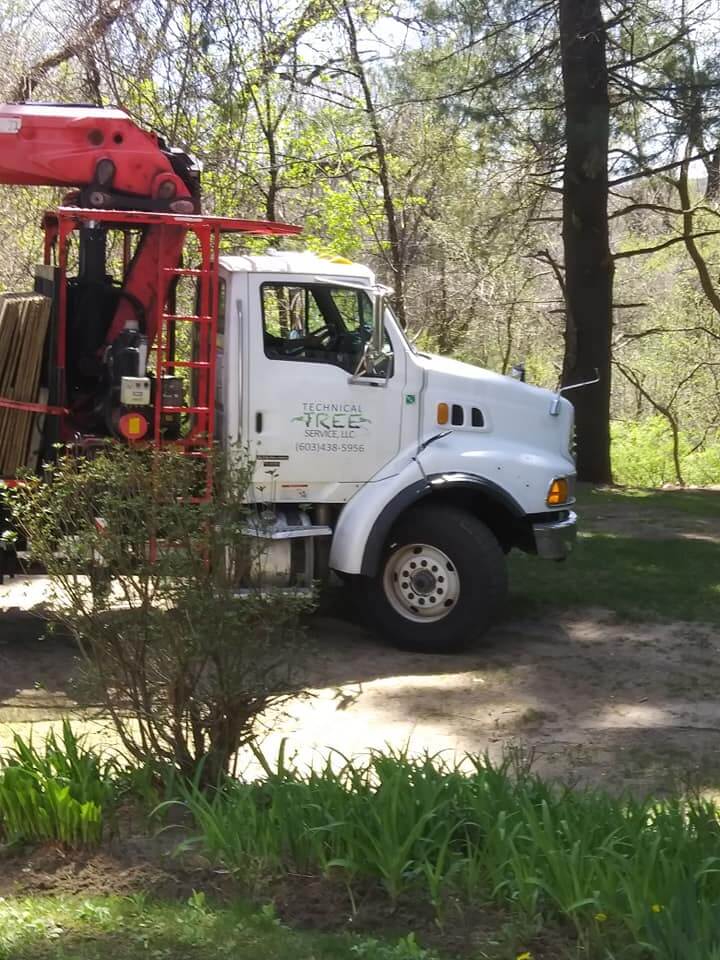
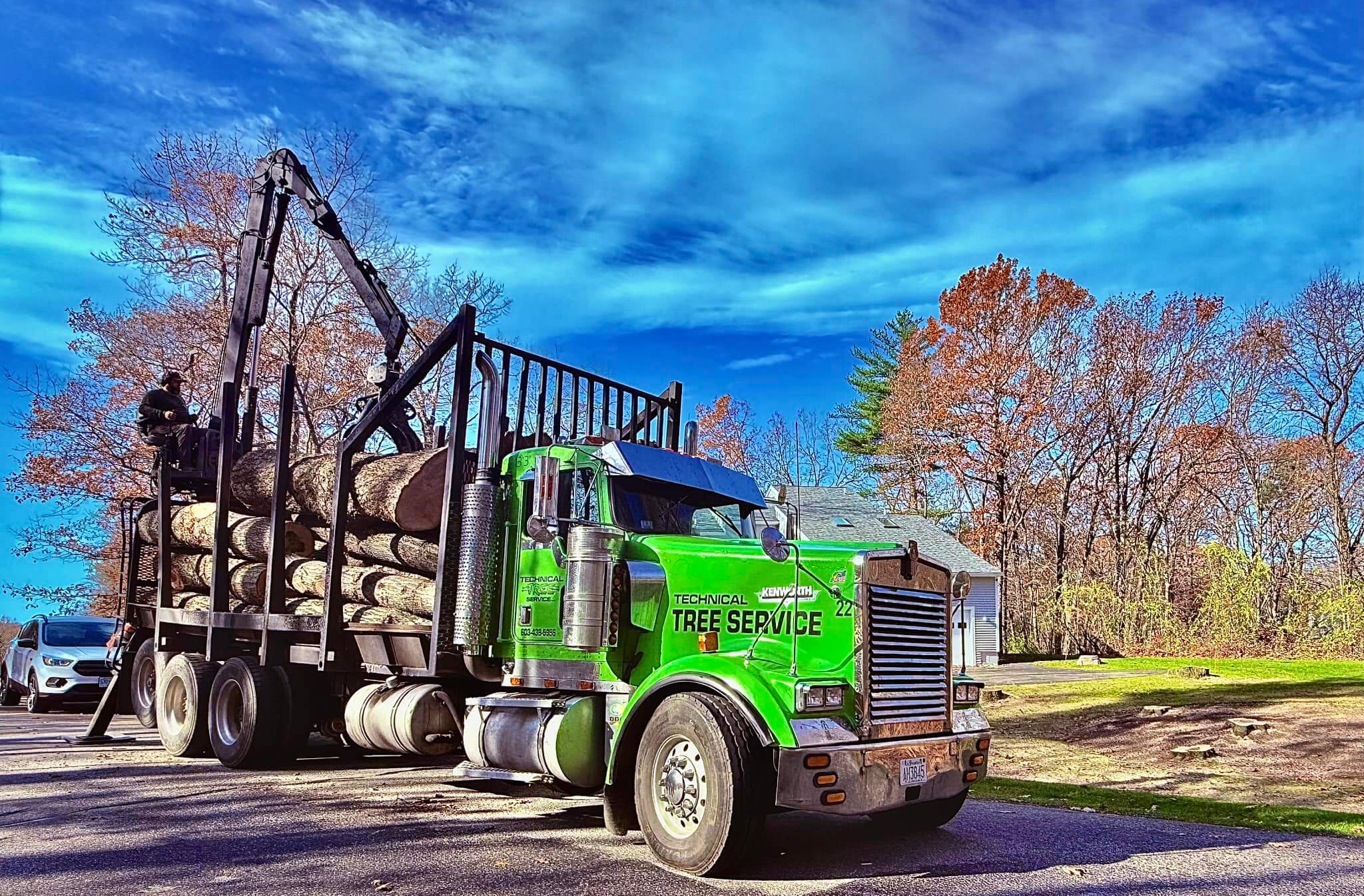
Technical Tree Service provides tree removal, pruning, stump grinding, storm damage response, Tree Health assessments, crane-assisted work, maintenance and 24/7 emergency tree service in Manchester. We own our cranes, are fully insured, and have an ISA Certified Arborist available for tree-care decisions. Technical Tree Service is also a member of the Tree Care Industry Association (TCIA).
No tree-removal or pruning price is quoted responsibly from tree height alone. Tree condition, access, nearby structures, equipment setup, utility conflicts and cleanup requirements need to be reviewed on site before the scope and price are established.
Why Choose Our Tree Service in Manchester
- Company-owned crane capability: controlled lifting is available when the tree and site justify crane-assisted removal.
- ISA Certified Arborist guidance: tree structure, pruning, Tree Health and removal decisions can be evaluated with professional arboriculture knowledge.
- 24/7 emergency availability: Technical Tree Service responds to storm-damaged trees, fallen limbs and urgent access hazards.
- Fully insured: insurance coverage is in place for tree-service operations.
- Tree care beyond removal: pruning, Tree Health, shrub care, Tree Fertilizer, Deep Root Fertilizer and ongoing maintenance are available when preservation is the better direction.
- On-site estimating: the job is inspected before planned work is priced.
Manchester is part of a larger Southern New Hampshire service area. Property owners with homes, rental properties or commercial sites in nearby communities can also use our Bedford tree service, Goffstown tree service, Hooksett tree service, Merrimack tree service, Nashua tree service and Concord tree service pages.
Technical Tree Service Approach & Safety
Every project begins with the tree and the space around it. In Manchester, that can mean a mature oak beside an older house, a white pine behind a narrow driveway, an ash near a street, or an ornamental tree growing between a sidewalk and the front of a building. The work plan changes when the drop zone is limited or equipment has to share space with residents, customers or traffic.
- Define work and exclusion zones before cutting starts.
- Choose between climbing, rigging, ground-based removal and crane-assisted removal.
- Evaluate equipment access, soil conditions and surfaces that need protection.
- Identify utility conflicts before work begins.
- Plan how limbs, logs and chips will move through the property.
- Clarify cleanup and the final condition of the work area.
Large-tree work is not safer simply because a crane is present. The tree still has to be assessed for structure, pick points, balance, access and surrounding targets. Likewise, pruning is not technically sound just because branches are removed. The objective, amount of live canopy removed, species and condition all matter.
Our Tree Services in Manchester
Tree Removal
Technical Tree Service removes dead, severely declining, storm-damaged, hazardous and unwanted trees. Manchester’s tighter lots can make a straightforward tree more complicated when limbs extend over a roof, fence, driveway, neighboring property or utility corridor. In those settings, removal may be completed in sections with rigging or a crane rather than dropping the tree in one piece.
For city-specific removal information, see our tree removal in Manchester, NH page.
Pruning & Maintenance
Pruning should have a reason: deadwood removal, structural improvement, clearance, storm-damage correction or management of branches that have developed poor attachments. Mature red oaks, sugar maples and other large trees need a different approach from young ornamentals.
Tree maintenance can also address Tree Health, root-zone conditions, shrubs and nutrition. If a tree looks thin, yellow or weak, Tree Fertilizer or Deep Root Fertilizer may be considered only after the likely cause is evaluated. Tree Food is a common term for fertilizer, but fertilizer does not repair root injury, drainage problems, structural defects or severe decay. A Manchester tree maintenance visit can separate those issues before treatment is selected.
Property owners sometimes search for a tree doctor or tree surgeon. Those are informal terms. For diagnosis, pruning and long-term care, an arborist assessment is the clearer starting point.
Stump Grinding
After removal, stump grinding can return surface space to the yard, parking edge or landscape bed. Technical Tree Service’s published stump-grinding process allows wood chips to be hauled away, used as mulch or left to decompose depending on the agreed scope. Underground utilities and the future use of the area need to be considered before grinding begins.
24/7 Emergency Tree Service
Technical Tree Service provides 24/7 emergency tree service for fallen trees, suspended limbs, dangerous leaning trees and blocked access. During a widespread weather event, call for the current arrival estimate rather than assuming a fixed response time.
Tree Health & Risk Assessment
A Tree Health assessment looks for symptoms such as canopy thinning, dead branches, cracks, cavities, fungal growth, root disturbance, insect activity and changes after construction or storms. The recommendation may involve pruning, monitoring, soil or root-zone care, treatment, cabling in appropriate situations, or removal when the condition and targets justify it.
Crane Service
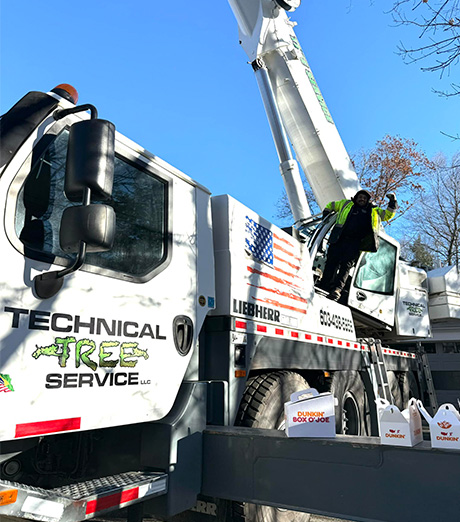
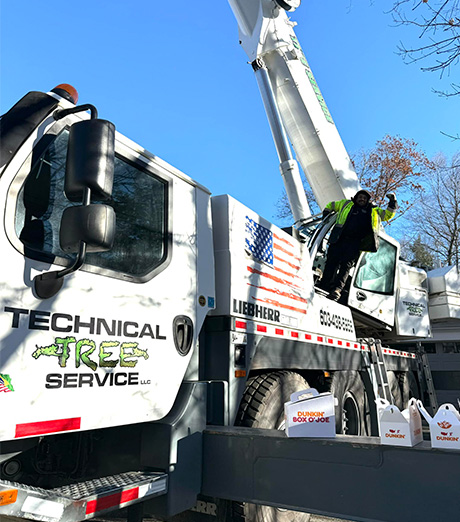
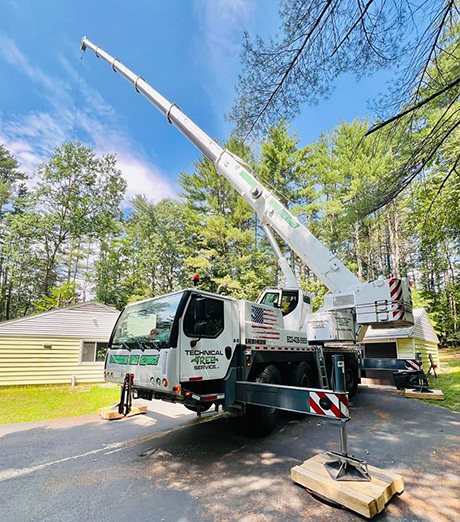
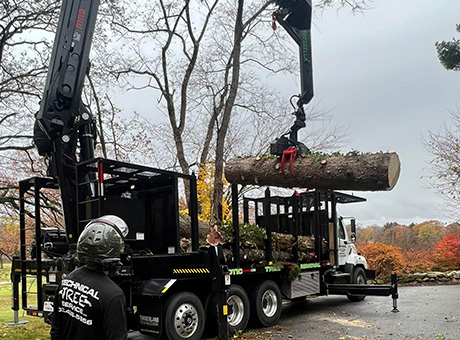
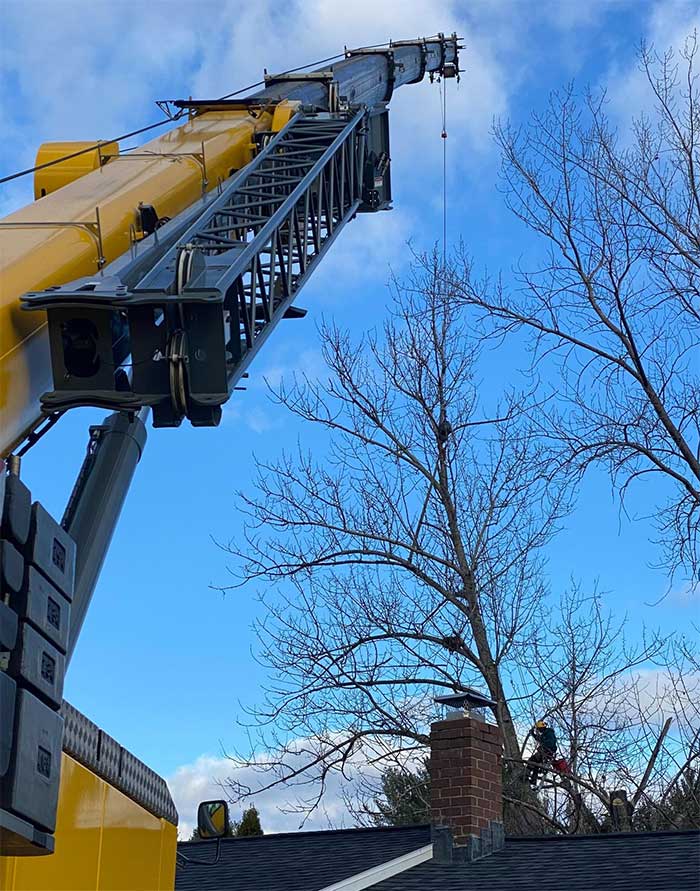
Technical Tree Service owns cranes and offers crane service in Manchester. Controlled lifting can be useful when large sections must be moved away from structures, small yards, driveways or other areas where free-falling material would create unnecessary risk.
Common Tree Species in Manchester & How We Care for Them
Manchester’s urban forest is diverse. The City’s current urban-forestry programs emphasize species diversity, and approved planting lists include red oak, white oak, American elm, crabapple and other urban-tolerant species. On existing properties, Technical Tree Service also encounters the larger New Hampshire species found throughout the Merrimack River valley and surrounding Southern New Hampshire.
Eastern White Pine
Eastern white pine can develop substantial height and long lateral limbs. In a city lot, the maintenance questions are often clearance, previous storm damage, deadwood, root-zone disturbance and whether the tree has enough space for its mature form. After heavy wet snow or high wind, inspect for broken tops and hanging limbs rather than trying to pull damaged material down from the ground.
Sugar Maple
Sugar maples can be sensitive to soil compaction, root damage, drought, road salt and changes in grade. Early fall color, sparse foliage or branch dieback can justify a Tree Health inspection. Fertilization should follow the diagnosis instead of being used as a default response to poor canopy color.
Red Oak
Northern red oak appears on Manchester’s current approved urban tree list. Mature red oaks can carry heavy scaffold limbs over roofs, driveways and sidewalks. Structural defects, dead branches and storm damage matter more when those limbs extend above occupied areas. Pruning should remove selected material for a defined purpose rather than aggressively reducing the entire canopy.
Ash Trees & Emerald Ash Borer
Ash trees require special attention because emerald ash borer is established in New Hampshire. Infested ash can decline and die within several years. Canopy decline, bark blonding caused by woodpecker activity and galleries beneath the bark can be warning signs. A declining ash near a house, parking area or street should be evaluated before deterioration advances.
Eastern Hemlock & Hemlock Woolly Adelgid
Hemlock woolly adelgid has been documented in Manchester. White woolly material around the base of hemlock needles is a recognizable sign. HWA can weaken hemlocks over time, and stressed trees may become more susceptible to other problems. Tree Health assessment helps determine whether monitoring, treatment or another management decision fits the tree.
Storm Damage Response: Ice Storms & Nor’easters in Southern NH
Nor’easters, wet snow, ice and strong wind place different loads on tree crowns. A tree that stood through previous storms can still develop a new crack, lose a major limb or shift at the root plate after the next event. Trees near houses, driveways, parked cars and utility lines deserve extra attention because the consequences of failure are higher.
Before severe weather, homeowners can walk the property from the ground and look for dead limbs, old storm breaks, open cracks, large cavities and branches already resting on structures. Do not climb a questionable tree or work around energized lines. After a storm, keep people away from hanging limbs and uprooted trees until the site can be evaluated.
Technical Tree Service provides storm damage cleanup and 24/7 emergency service. If a tree has fallen onto electrical equipment or a line is down, treat the line as energized and contact the utility before approaching the tree.
Emergency tree hazard in Manchester? Call (603) 438-5956.
Emergency Tree Service: 24/7 Response Times in Manchester
Technical Tree Service is available 24/7, but we do not publish a guaranteed citywide arrival time for every Manchester emergency. Travel, active storm conditions, blocked roads, utility hazards and the number of simultaneous emergency calls can all change response time.
When you call, describe what has happened: whether the tree is on a structure, blocking the only driveway, hanging over an occupied area, or involved with power lines. That information helps determine urgency and what equipment may be needed. If the scene involves a downed electrical line, fire, injury or another immediate life-safety issue, contact the appropriate emergency service or utility first.
Crane-Assisted Removal: When & Why We Use It
A crane can be the better method when a tree has to be dismantled in controlled sections and there is suitable setup space. The crane can lift material away from a roof, fence, pool, driveway or neighboring property rather than requiring each piece to be lowered through a congested drop zone.
Traditional climbing and rigging may still be the better choice when crane access is poor, the setup area is unsuitable or the tree can be safely handled without lifting equipment. Cost also depends on more than whether a crane is used. Tree condition, number of picks, access, traffic control, cleanup and stump work all affect the scope.
Technical Tree Service evaluates the tree on site before deciding whether crane-assisted tree work or traditional rigging makes more sense.
Our TCIA-Certified Team & Safety Protocols
Credential clarification: Technical Tree Service is a TCIA member, not a company with an individual “TCIA Certified Arborist” credential. The individual arborist credential we can verify is ISA Certified Arborist. TCIA membership, ISA certification and New Hampshire Arborists Association certification are separate things, and this page keeps those distinctions clear.
Technical Tree Service also has an ISA Certified Arborist available. The International Society of Arboriculture (ISA) explains that its Certified Arborist credential requires documented experience and examination, with continuing education needed to maintain the credential. Certification measures professional knowledge; it is not a government license and does not guarantee the performance of every worker on a job.
The New Hampshire Arborists Association operates a separate voluntary New Hampshire certification program. NHAA also notes that New Hampshire does not require a statewide arborist license. Technical Tree Service does not present TCIA membership, ISA certification and NHAA certification as if they were the same credential.
On the job site, safety planning still depends on the tree, equipment, crew roles, access, electrical hazards and work zone. Arborist knowledge supports the decision; it does not replace a site-specific plan.
Tree Health, Shrub Care, and Preventive Maintenance
Tree service does not have to begin with removal. Healthy or recoverable trees may benefit from pruning, soil and root-zone care, monitoring, shrub maintenance or nutrition management. The right approach depends on what is causing the decline.
Urban properties can create root stress through pavement, compacted soil, construction, road salt, limited rooting volume and repeated foot or vehicle traffic. A thin canopy or yellow leaves can be caused by nutrient conditions, but similar symptoms can come from root injury, excess water, drought, insects or disease.
Technical Tree Service provides arborist services in Manchester and maintenance work that can include Tree Health evaluation, shrub care, soil review, Tree Fertilizer and Deep Root Fertilizer recommendations when the diagnosis supports treatment.
Seasonal Tree Care Calendar for Manchester Homeowners
Late Winter & Early Spring
Inspect for branches broken by snow and ice, old cracks that opened further during winter, and trees that changed position. Before leaves emerge, branch structure on deciduous trees is often easier to see. Planned pruning may be appropriate for some species and objectives.
Spring
Watch how trees leaf out. A tree that leafs out late, unevenly or sparsely may deserve inspection. Spring is also a good time to check mulch depth, buried root flares, shrub condition and signs of pests.
Summer
Look for drought stress, premature leaf drop, canopy thinning, dead tips and construction-related root damage. Trees in compacted urban soil can respond differently from the same species in a larger wooded site.
Fall
Review deadwood and structure before winter weather. If soil testing, root-zone care or fertilization is being considered, base the treatment on the actual condition of the tree and soil rather than a standing annual application.
After Major Wind, Ice or Heavy Snow
Reinspect trees near buildings, driveways and occupied areas. New hanging branches, splits, uprooting or contact with utilities can change a normal maintenance issue into an emergency.
Working with Manchester City Permits & Utility Coordination
Tree work entirely on private property is different from work that occupies a sidewalk, lane or City right-of-way. The Manchester Department of Public Works permit guidance states that work in the City right-of-way will often require City approval. If tree equipment or a work zone temporarily narrows or closes a pedestrian walkway, traffic lane or another portion of the right-of-way, an encumbrance permit may be required.
Manchester also has an active urban-forestry program. City tree planting and right-of-way tree work can involve the Urban Forester and DPW, so property owners should not assume a tree between the sidewalk and street is managed exactly like a tree in the back yard.
Eversource Energy and Overhead Electric Lines
Eversource Energy operates vegetation-management programs in New Hampshire. Eversource states that property owners can hire professional tree contractors for some work around the service line, and the utility may temporarily remove the pole-to-house line when appropriate. Utility-controlled conductors and line-clearance work remain subject to the utility’s requirements.
Liberty Utilities and Underground Gas
Liberty Utilities provides natural-gas service in Manchester. Stump grinding, excavation, crane setup and other work that disturbs soil should account for buried utilities. Call 811 before excavation or digging work and follow the utility-marking process before work proceeds near underground facilities.
Technical Tree Service’s current Manchester page states that the company assists with permits when needed and coordinates safely with local utilities. The City or utility still determines its own approvals, shutdowns, line clearance and right-of-way requirements.
Eco-Friendly Debris Disposal & Wood Recycling
Tree debris does not have one required destination on every job. Technical Tree Service’s published stump-grinding information states that chips can be hauled away, used as mulch or left to decompose depending on the agreed scope. The company’s tree-removal information also indicates that wood can be hauled away or cut into pieces for the property owner.
For emergency work, Technical Tree Service states that removed material is recycled into mulch or lumber where possible. That does not mean every log from every Manchester job is automatically milled or donated. Wood species, condition, contamination, size, access and the scope approved by the customer can change what is practical.
Manchester’s municipal yard-waste program accepts only material within published size limits, so large tree-service debris should not be placed curbside under the assumption that City collection will take it. For a planned job, decide in advance whether chips stay, logs stay, material is hauled away, or stump grindings will be reused on site.
Before & After: Recent Manchester Tree Projects
Before-and-after project photos are most useful when they show more than a finished empty space. For a Manchester project, the useful details are the tree species when known, the condition that prompted work, nearby structures or utilities, equipment access, the selected removal or pruning method, and the final cleanup.
Technical Tree Service’s public website currently includes a gallery and many job photos, but the published photo data does not reliably attach a Manchester address or neighborhood to each image. We do not relabel a general Southern New Hampshire project as a Manchester job without location confirmation.
For a property with a large oak near a house, a white pine over a narrow backyard, storm-damaged limbs or a tree requiring crane access, ask during the on-site visit to see project examples with similar access and tree conditions. New verified Manchester before-and-after projects can be added to this section as the city, date, tree and scope are confirmed.
Customer Testimonials from Bedford, Nashua, and Concord
Technical Tree Service’s website currently displays Google-sourced reviews verified through Trustindex. The review feed does not publish the reviewer’s city beside every testimonial, so we do not assign a Manchester, Bedford, Nashua or Concord location to a reviewer unless that location is confirmed.
- Robin Simard, July 2026: described repeat work that included a prior multi-tree removal and a later visit to professionally fertilize arborvitae that appeared stressed.
- Nigel Jenkins, July 2026: described pruning three large trees and branch removal, with the surrounding grass and plants protected and the site cleaned afterward.
- Willie Walker, July 2026: highlighted communication, crew skill and cleanup.
Technical Tree Service serves Manchester as well as nearby Bedford, Nashua, Concord, Goffstown, Hooksett and Merrimack. When a review does not identify a city, it should be treated as company-wide customer feedback rather than a city-specific testimonial.
Signs a Manchester Tree Needs a Closer Look
- Large dead or hanging branches
- A new crack in the trunk or a major branch union
- Visible cavities or extensive decay
- Fungal fruiting bodies around the trunk or root zone
- A tree that suddenly leans or a root plate that lifts
- Canopy thinning or repeated early leaf drop
- Storm damage that changed the tree’s balance
- Construction, trenching or grade changes near major roots
- Ash decline consistent with emerald ash borer damage
- White woolly material on hemlock twigs consistent with hemlock woolly adelgid
The presence of one symptom does not automatically mean removal. Tree Health, structural condition, the likelihood of failure and what could be struck if a failure occurs all contribute to the management decision.
What to Expect from Our Service
- On-site evaluation: planned work is reviewed at the property before pricing.
- Defined scope: the estimate can identify removal, pruning, stump work, cleanup and equipment needs.
- Method selected for the property: crane, climbing, rigging and ground operations are chosen from access and tree conditions.
- Utility and permit awareness: right-of-way and utility issues are addressed when they apply.
- Cleanup expectations: chips, logs, stump grindings and debris handling are clarified before the job.
FAQs – Tree Service in Manchester, NH
What tree species are most common in Manchester, NH, and what specific care do they need?
Manchester properties commonly contain Eastern white pine, sugar and red maple, red and white oak, ash, hemlock and ornamental species such as crabapple. Care depends on species and site conditions. Mature oaks benefit from deadwood and structural review where large limbs extend over houses or streets. Maples can show stress from compaction, road salt, drought or root disturbance. Ash should be monitored for emerald ash borer, while hemlock should be checked for hemlock woolly adelgid. White pines deserve inspection after heavy snow, ice and strong wind because broken tops and large lateral limbs can create hazards.
How do ice storms and nor’easters impact trees in the Merrimack Valley, and what emergency prep should homeowners do?
Wet snow and ice increase branch weight, while nor’easter winds test branch unions, old cracks, deadwood and root stability across the Merrimack Valley. Before a storm, inspect from the ground for hanging dead limbs, open cracks, weakly attached stems and branches already contacting structures. Move vehicles and outdoor items away from questionable trees when practical, keep people out of known drop zones, and do not attempt work near energized lines. After the storm, stay clear of split trunks, uprooted trees and suspended limbs. For an urgent Manchester tree hazard, call (603) 438-5956 for current 24/7 emergency availability.
What does a TCIA-certified arborist bring to a tree removal or health assessment that an unlicensed crew does not?
The wording needs one correction: TCIA does not issue the ISA Certified Arborist credential, and New Hampshire does not require a statewide arborist license. Technical Tree Service is a TCIA member and has an ISA Certified Arborist available. An ISA Certified Arborist has documented arboriculture experience and has passed an examination covering areas such as tree biology, pruning, diagnosis, soil management, risk and safe work practices. That knowledge can improve the quality of pruning, Tree Health assessment and removal planning compared with relying only on cutting experience, while the actual job still requires a site-specific safety plan.
How does Technical Tree Service handle wood debris—do you chip, recycle, or donate usable lumber?
Debris handling is defined in the job scope. Technical Tree Service can chip brush, haul material away, leave usable wood cut into pieces for the property owner, and handle stump grindings as mulch, removed material or material left to decompose depending on the project. The company’s emergency-service information also states that removed material is recycled into mulch or lumber where practical. That does not mean every log is automatically donated or milled; species, condition, size, contamination, access and customer preference affect what can be reused.
What are the permit requirements for tree removal in Manchester, and do you handle the paperwork?
A typical removal entirely on private property is different from work that occupies a Manchester sidewalk, traffic lane or other public right-of-way. Manchester DPW requires permits for certain right-of-way work, and an encumbrance permit may be required when equipment or a work zone narrows or closes public access. City-owned or right-of-way trees can involve the Urban Forester or DPW. Technical Tree Service can assist with permit and utility coordination when it applies, but the City determines whether a permit is required and issues the approval.
Do you coordinate with Eversource Energy or Liberty Utilities?
Yes, Technical Tree Service’s published Manchester service information states that utility coordination is available when needed. Eversource Energy controls work and clearances involving its electrical system. Liberty Utilities provides natural-gas service in Manchester, so buried gas lines also matter when stump grinding or excavation is planned. Utility locates and utility instructions take priority around energized or underground infrastructure.
How quickly can you respond to a downed tree blocking a driveway or damaging a roof in Manchester?
Technical Tree Service provides 24/7 emergency service in Manchester, but we do not publish one guaranteed arrival time for every call. Active storms, road conditions, utility hazards, travel and the number of simultaneous emergencies can change response time. Call (603) 438-5956 and describe whether the tree is on a structure, blocking the only access, hanging over an occupied area or involved with power lines so current availability and urgency can be assessed.
When is crane-assisted removal safer or more cost-effective than traditional rigging?
Crane-assisted removal can be safer and more efficient when large sections need to be lifted away from a house, narrow driveway, fence, pool, street or tight drop zone and there is suitable setup space. It can reduce the amount of lowering and ground handling required on some jobs. Traditional climbing and rigging can be more practical when crane access is poor or the tree can be dismantled safely without lifting equipment. Cost-effectiveness depends on setup, number of picks, tree condition, access, traffic control, cleanup and the amount of material being handled, so the method is selected after an on-site inspection.
What signs indicate a tree is diseased or at risk of falling, and how do you assess tree health?
Warning signs can include large dead branches, cracks, cavities, fungal growth, root movement, a new lean, canopy thinning, abnormal leaf loss, bark changes, storm damage and major root disturbance. Ash decline may also show signs associated with emerald ash borer, while hemlocks can show white woolly material associated with hemlock woolly adelgid. A Tree Health assessment considers the whole tree: roots, trunk, branch structure, canopy, site history, soil and nearby targets. No single symptom automatically means removal; pruning, monitoring, treatment, root-zone care or removal may be considered depending on the findings.
Do you give quotes over the phone or by photo?
No. Technical Tree Service requires an on-site visit to evaluate tree size, condition, access and surrounding hazards before planned work is priced.
Are you insured?
Yes. Technical Tree Service is fully insured for tree-service operations.
Do you have a certified arborist?
Yes. An ISA Certified Arborist is available for pruning, Tree Health, maintenance and removal decisions.
Do you provide emergency service in Manchester?
Yes. Technical Tree Service provides 24/7 emergency response for storm damage, hazardous limbs, fallen trees and blocked access.
Schedule Tree Service in Manchester, NH
If you have a declining tree, storm damage, a stump taking up usable space, branches over a roof, or a large removal that may need a crane, Technical Tree Service can inspect the property and define the right scope before pricing.
Call (603) 438-5956 to schedule tree service in Manchester, NH, or request an on-site estimate.