A useful tree maintenance schedule in Bedford does not assign the same job to every tree every spring, summer, fall and winter. The seasons give you different opportunities to inspect the tree. What you do next depends on species, condition, weather, previous pruning and what has changed around the property.
For homeowners planning tree maintenance in Bedford, NH, a practical schedule looks like this: inspect winter damage in spring, watch foliage and moisture through summer, prepare for cold-weather stresses in fall, and use winter dormancy to evaluate structure and plan appropriate pruning.
Some years that leads to tree work. Other years, monitoring is enough.
Spring: find out what winter left behind
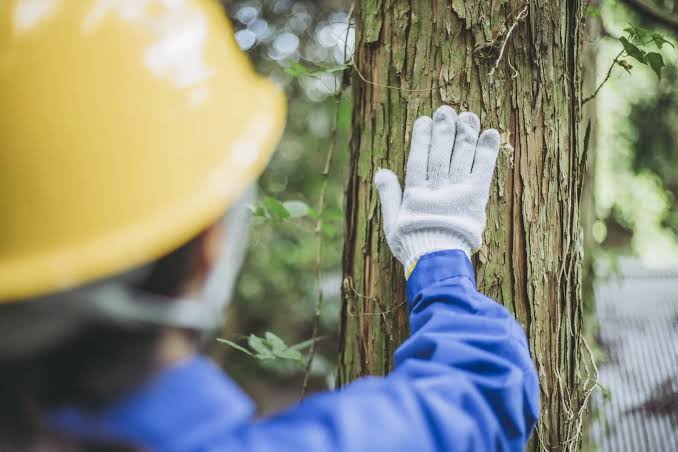
Spring is a good time to walk the property before the canopy becomes dense.
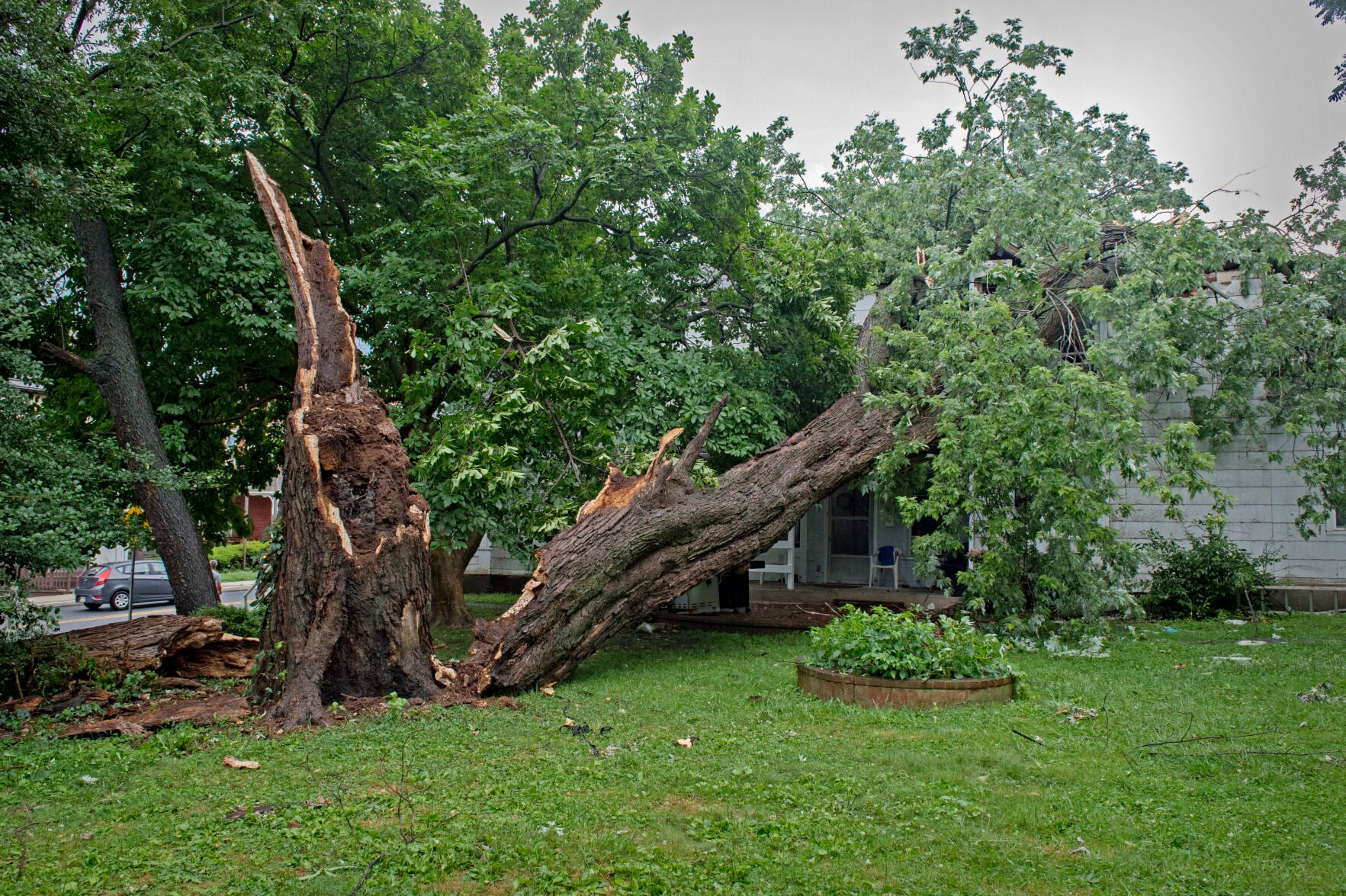
New Hampshire winters can leave broken branches, cracked limbs, bent young trees, damaged leaders and other problems caused by snow, ice and wind.
Start from the ground.
Stand far enough away to see the entire tree. Look for branches that no longer match the rest of the crown, hanging wood, new gaps, or limbs that appear to have shifted.
Then look closer at the trunk and major unions.
Winter damage is sometimes obvious. A broken limb may still be suspended in the canopy. Other changes are subtle and become easier to recognize when you compare the tree with how it looked the previous year.
If large broken wood is overhead, keep the inspection at ground level.
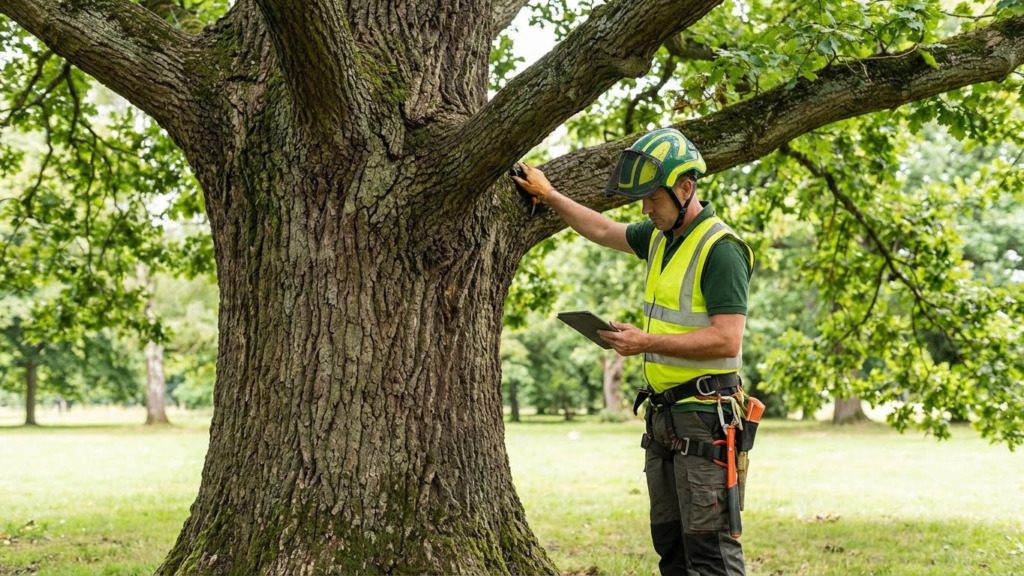
On our tree maintenance in Bedford, NH page, we include post-winter inspection as one of the first seasonal priorities because it gives us a chance to separate normal seasonal change from damage that may need pruning or closer evaluation.
Late winter and early spring can be good pruning windows, but species still matters
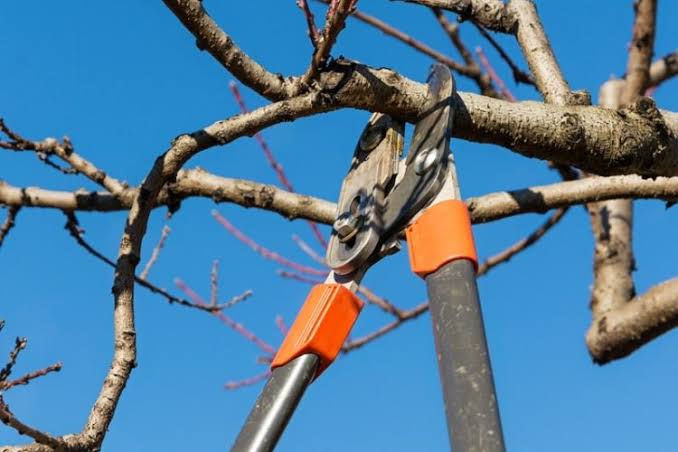
For many deciduous trees and shrubs in New Hampshire, late dormancy is a useful time for planned pruning.
Without leaves, branch structure is easier to see. Insects and many pathogens are less active, and the tree has not yet entered its full spring growth period.
Late February into early March is often a useful pruning window in New Hampshire, depending on weather and species.
That does not make March the correct month for every tree.
Spring-flowering trees and shrubs often form their flower buds before winter. Pruning them during dormancy may remove much of that year’s bloom. Those plants are commonly pruned after flowering when pruning is needed.
Some disease concerns also change timing.
Start with the tree and pruning objective rather than the month.
Spring pruning should answer a specific problem
Pruning is easier to justify when the objective can be stated clearly.
A branch is broken from winter loading.
Deadwood hangs over a driveway.
Two branches are rubbing and creating repeated injury.
A young tree has a structural issue that can be corrected while the branches are still relatively small.
Those are different from removing branches because the canopy looks full.
If the tree came through winter with good structure and no clearance problem, it may not need spring pruning at all.
That restraint matters for mature trees. Every live branch removed also removes leaf area and creates a wound the tree must respond to.
Do not make spring fertilizer automatic
Spring growth makes fertilizer sound like an obvious seasonal task.
It is not automatic.
Many established trees in residential landscapes already have adequate access to nutrients. If foliage looks normal, annual growth is appropriate for the species and there is no diagnosed deficiency, adding fertilizer may accomplish little.
Other problems can imitate nutrient deficiency.
Drought, poor drainage, compacted soil, root injury and disease can all affect leaf color and growth.
A soil test can help distinguish some of those situations.
When we evaluate a tree with weak growth or unusual foliage, we would rather understand the soil, root zone and tree condition before treating fertilizer as the answer.
Refresh mulch in spring if the existing layer needs it
Mulch helps moderate soil temperature and moisture while reducing competition from turf and keeping lawn equipment farther from the trunk.
A layer around 2 to 4 inches deep is generally enough.
More is not necessarily better.
Keep mulch away from direct contact with the trunk and leave the root flare visible. A tall mound against the bark traps moisture where the tree is not designed to have it.
If last year’s mulch is still at an appropriate depth, another full load may not be needed.
Check before adding.
Spring is also the time to establish a baseline
When leaves emerge, watch the pattern rather than expecting every branch to look identical.
Is one section leafing out much later than the rest?
Did a branch that was alive last summer fail to leaf out?
Are leaves unusually small?
Is part of the crown noticeably thinner than it was?
Those observations become useful later in the year.
On our tree health assessment page, we explain why canopy condition is considered together with the trunk, branch unions, root flare, surrounding soil and recent site changes.
A sparse crown can have more than one cause.
Summer: watch how the tree performs under full load
By summer, deciduous trees have a full canopy and are responding to heat, rainfall, insects, diseases and the demands of active growth.
This makes summer a good observation season.
Look at crown density.
Watch for premature leaf drop.
Notice whether foliage changes color early or curls during dry periods.
Pay attention to dead branches that become easier to distinguish against green foliage.
Also note where problems appear. One declining branch can suggest a different issue from thinning across the whole canopy.
Water according to soil conditions, not a weekly alarm
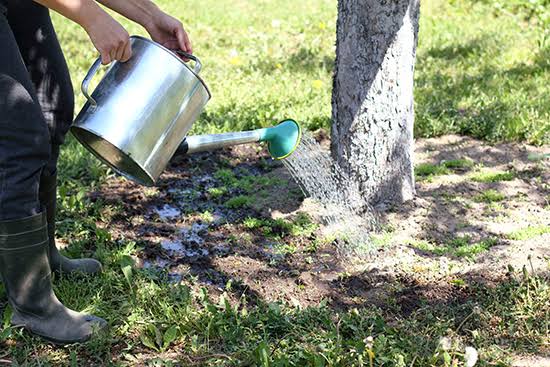
Established trees can tolerate longer intervals between irrigation than new trees, but extended dry weather still creates stress.
When watering is needed, concentrate on the root zone instead of pouring water against the trunk.
A slow application over a wider area allows moisture to move into the soil where absorbing roots are located.
The exact schedule depends on rainfall, soil texture, slope, drainage, tree species and competition from surrounding vegetation.
A sandy site can dry quickly.
Heavy soil may retain moisture much longer.
After a wet stretch, adding more water because the calendar says Saturday can create a different problem.
For seasonal tree care in Bedford, NH, rainfall and soil condition are better guides than a fixed seven-day schedule.
Recently planted trees need different summer attention
A mature oak and a tree planted last year do not have the same root system.
Newer trees have not yet developed roots across a large volume of surrounding soil, so they are more sensitive to missed irrigation during dry weather.
They also need the planting area checked for settling, mulch placement and trunk damage.
A young tree that rocks in the soil or has a buried root flare deserves attention for reasons that have little to do with watering.
Age changes the maintenance plan.
Summer is a good time to monitor pests without assuming every insect requires treatment
Full foliage makes many symptoms easier to see.
Chewing damage, unusual leaf distortion, premature discoloration, thinning sections and insects on leaves or bark can become more visible as the growing season progresses.
New Hampshire has several invasive forest-health concerns, including emerald ash borer, hemlock woolly adelgid, elongate hemlock scale and beech leaf disease.
Finding an insect on a tree does not automatically mean it caused the symptom.
Identification comes first.
Treatment decisions depend on the pest, host species, level of damage, tree condition and timing within the pest’s life cycle.
Summer pruning has a place, but it is not the default for every tree
Summer can be useful for targeted work.
Dead branches are easier to distinguish in a fully leafed crown.
A broken branch may need correction after a storm.
Clearance problems may become obvious when branches are carrying a full load of foliage.
Heavy pruning is another matter.
Removing a large amount of live canopy during active growth changes the tree’s available leaf area at the same time it is supporting the rest of the crown.
The objective and tree condition should justify that dose of pruning.
Maples and birches do not need summer pruning simply because they may bleed sap
Some seasonal guides push maple and birch pruning into summer because cuts made near spring can release visible sap.
That sap flow can look alarming.
It does not mean summer is automatically the only correct pruning season.
Species, disease considerations, branch size and the reason for pruning still matter.
If the main reason for changing the schedule is cosmetic concern about sap, that should be separated from actual tree-health considerations.
Treat branches near power lines as a separate safety issue
A branch touching a house is one kind of clearance problem.
A branch near an energized utility line is another.
Do not treat utility clearance as routine DIY pruning.
If wires are involved, identify who owns the line and contact the utility or an appropriately qualified tree professional before cutting.
After a summer storm, the calendar stops mattering
A damaged branch does not become safer because late winter would normally be a better pruning season.
After thunderstorms or strong wind, inspect from a safe location.
Look for newly hanging limbs, broken tops, cracks at branch unions, root movement or a sudden change in lean.
If a branch is suspended overhead, avoid walking underneath it.
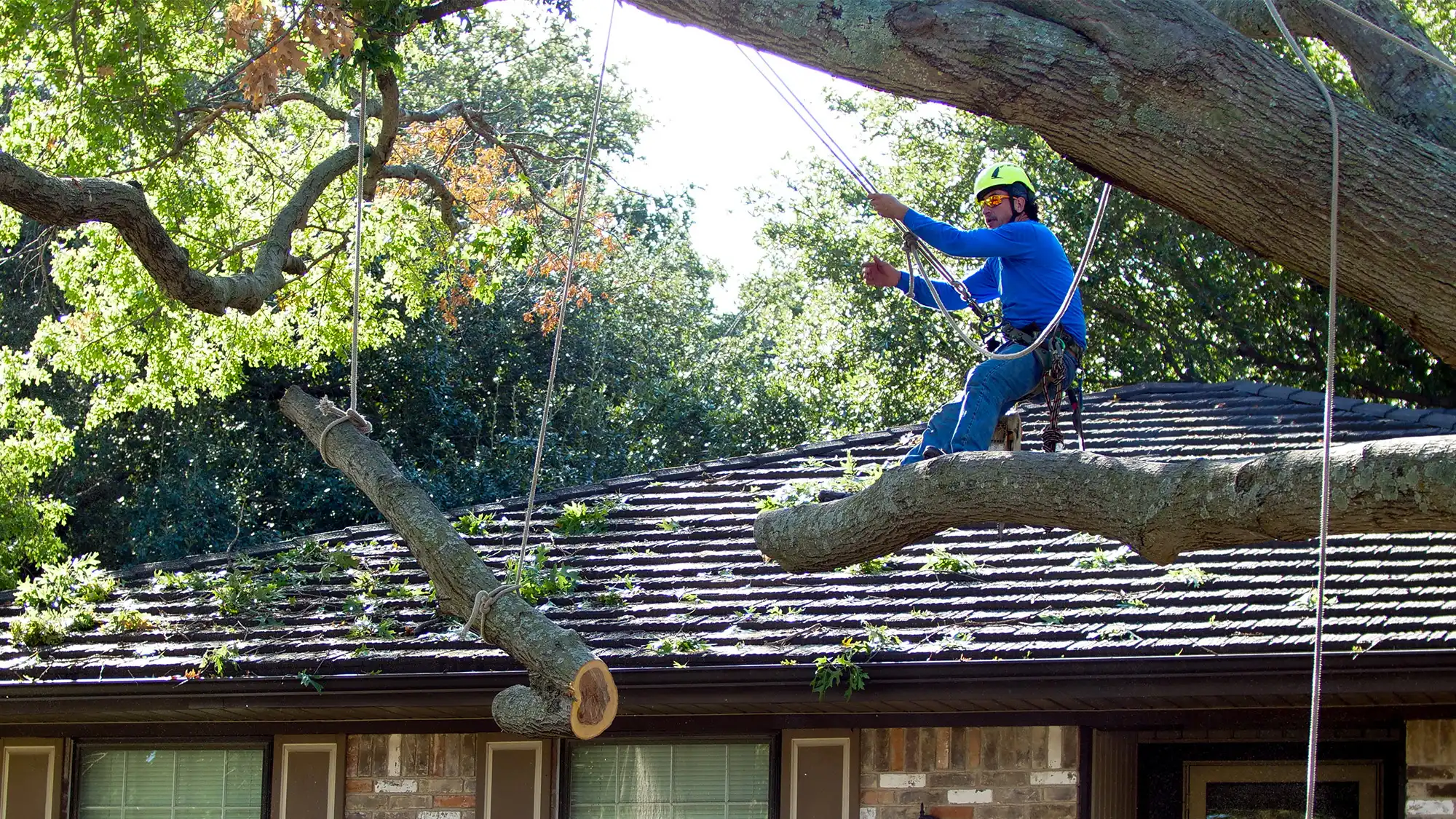
Our guide to the types of tree service and when you need them separates scheduled pruning and maintenance from storm cleanup, assessment and emergency work.
That distinction is useful throughout the year.
Fall: prepare for winter without turning the yard upside down
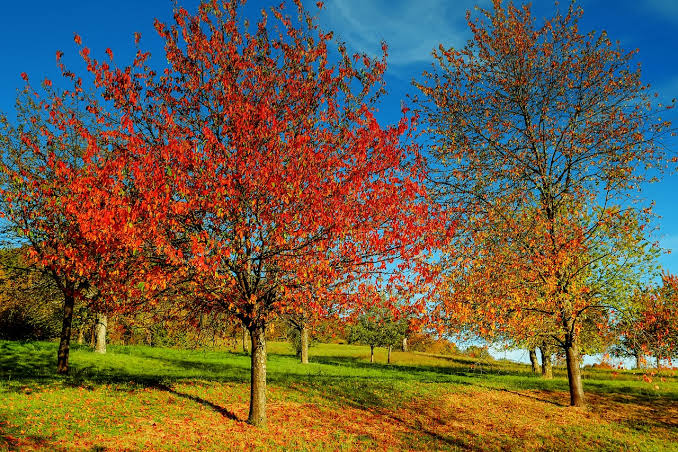
Fall is a transition season.
Trees are moving toward dormancy while homeowners are thinking about leaf cleanup, winter storms and the condition of branches above roofs or driveways.
This is a good time to review what changed during summer.
Did a branch die?
Did the canopy thin?
Did drought stress leave part of the tree in poor condition?
Did a summer storm create a crack that was never evaluated?
Those questions are more useful than automatically scheduling a large fall pruning.
Fall inspection should focus on winter exposure
Snow and ice add load to branches.
Wind affects trees differently once surrounding leaves are gone.
Look at branches over roofs, driveways, parking areas, walkways and other places where failure would matter.
Deadwood and damaged limbs deserve attention.
So do new cracks or branch unions that appear to have changed.
A preventive inspection cannot guarantee that a tree will survive every storm, but it can identify conditions that deserve closer attention before winter weather arrives.
Healthy leaves and diseased leaves do not need the same cleanup strategy
It is common to hear that all fallen leaves should be removed to prevent disease.
That is too broad.
When a tree has a disease that survives in infected leaf litter, cleanup can reduce material that produces new spores the following season.
Healthy leaves are different.
They can break down on site, contribute organic matter and provide winter habitat.
If a thick mat is smothering lawn or groundcover, redistribute or manage the excess.
Make the cleanup decision based on what the leaves are doing, not simply because they fell.
Fall watering is most useful when the season has been dry
Trees entering winter after a prolonged dry period may benefit from additional moisture while the soil remains able to absorb water.
This can be especially relevant for newly planted trees and evergreens, which continue losing water through their foliage during winter.
It does not mean every established tree needs a ceremonial “final watering” before the first freeze.
Check soil moisture and recent rainfall first.
If fall has already been wet, another deep irrigation may not be useful.
Protect young trees from rodents before snow hides the problem
Voles can feed on bark under snow cover, sometimes girdling young fruit and landscape trees.
Physical guards can help, but guard design and maintenance matter.
Check guards each season.
They should protect the trunk without becoming a new source of rubbing, constriction or hidden pest activity.
Fall is usually a planning season for major elective pruning
For many ornamental trees and shrubs in New Hampshire, late dormancy is a more useful pruning window than late summer or fall.
That gives homeowners a practical planning season.
You can identify what needs attention in fall, document it, and schedule appropriate work for the dormant season.
Hazardous conditions are the exception.
A broken branch over an occupied area is not something to preserve until February for the sake of timing.
Safety changes the priority.
Winter: use bare branches to understand structure
Once deciduous leaves are gone, branch architecture becomes easier to see.
Crossing limbs, competing stems, weak attachments and previous pruning cuts may stand out in ways they did not during summer.
Snow can also reveal imbalance.
A branch that repeatedly bends much farther than surrounding limbs deserves another look.
This makes winter useful for tree inspection in Bedford, NH, especially when the objective is planning structural work rather than reacting to an active emergency.
Late winter is a strong pruning window for many Bedford trees
For many deciduous species, late winter offers good visibility and falls within the dormant period.
Late February into March is a common pruning period in New Hampshire, depending on weather and species.
The word “many” matters.
Spring bloomers may be scheduled after flowering.
Specific disease concerns can change timing.
Fruit trees have their own management considerations.
Before making large cuts, confirm what species you have and what the pruning is meant to accomplish.
Winter pruning is not an excuse for topping
A leafless tree can make large cuts look deceptively simple.
Reducing the height of a tree by indiscriminately cutting major limbs leaves large wounds and can produce weakly attached regrowth.
Proper reduction pruning works back to appropriate laterals and should be tied to a real objective.
For large trees, that requires understanding branch structure, load and the response expected after the cut.
Dormancy improves visibility. It does not make poor cuts harmless.
Dormant oil is a treatment, not a winter ritual
Some fruit and ornamental trees can benefit from horticultural oil when there is a target pest and the timing is correct.
That timing is more specific than “spray in winter.”
Application depends on the type of tree, stage of bud development, weather and life cycle of the insect being targeted.
If there is no known pest problem or monitoring reason, adding a spray because January arrived is not a maintenance plan.
Snow and ice damage may need attention before spring
Winter pruning can be scheduled.
Storm damage cannot always wait.
After heavy snow, ice or wind, check trees from a safe distance.
Do not pull on loaded branches or stand beneath cracked wood.
Watch for newly split unions, hanging branches, tipped root plates or trees resting against structures.
If utilities are involved, keep away from the area and contact the utility.
When the immediate hazard is controlled, the remaining tree can be evaluated for its longer-term condition.
A seasonal schedule works better when you keep records
Take photographs from the same locations during the year.
Spring photos show leaf emergence.
Summer photos show full crown density.
Fall gives you a comparison before leaf drop.
Winter exposes branch structure.
Over several seasons, those images can reveal changes that are difficult to remember accurately.
You can also note storm dates, drought periods, pruning, construction near the root zone and pest symptoms.
If we later inspect a tree, that history gives us useful context.
Your Bedford schedule can be simple
You do not need professional tree work four times a year.
For many properties, the homeowner’s schedule is mostly observation.
Spring: check winter damage and canopy development.
Summer: watch water stress, foliage, pests and storm damage.
Fall: review structure and moisture before winter.
Winter: use dormancy to plan appropriate pruning and look at branch architecture.
Professional work enters the schedule when those observations reveal a reason.
That is the difference between a seasonal plan and seasonal busywork.
When a seasonal inspection should turn into a professional assessment
Some conditions deserve more than observation:
- a new or increasing lean;
- large hanging or broken limbs;
- cracks at major branch unions;
- mushrooms or fungal growth at the trunk or root flare;
- sudden canopy thinning;
- extensive premature leaf drop;
- root damage after construction;
- repeated branch failures;
- deadwood positioned over occupied areas;
- storm damage near a home, driveway or utility line.
One symptom does not automatically determine the service.
An assessment may lead to pruning, monitoring, soil or root-zone work, pest identification, additional testing or, where preservation is no longer practical, removal.
Bedford tree maintenance should follow the tree, not a generic calendar
On our Bedford tree maintenance page, we use seasonal changes as checkpoints rather than reasons to prescribe the same work every year.
When we inspect a property, we look at the tree, the site and what the homeowner is trying to accomplish.
Our broader tree service in Bedford, NH includes pruning, tree health and risk assessment, storm response, removal and other work when those services fit the condition we find.
For homeowners just outside Bedford, we also provide tree maintenance in Merrimack, NH using the same site-specific approach.
If you want to establish a seasonal baseline for trees on your Bedford property, we can start with an on-site inspection. We will look at current structure, visible health concerns, root-zone conditions and recent changes before recommending work.
Sometimes the next step is pruning.
Sometimes it is monitoring until the next season.
A useful maintenance schedule should help you tell the difference.